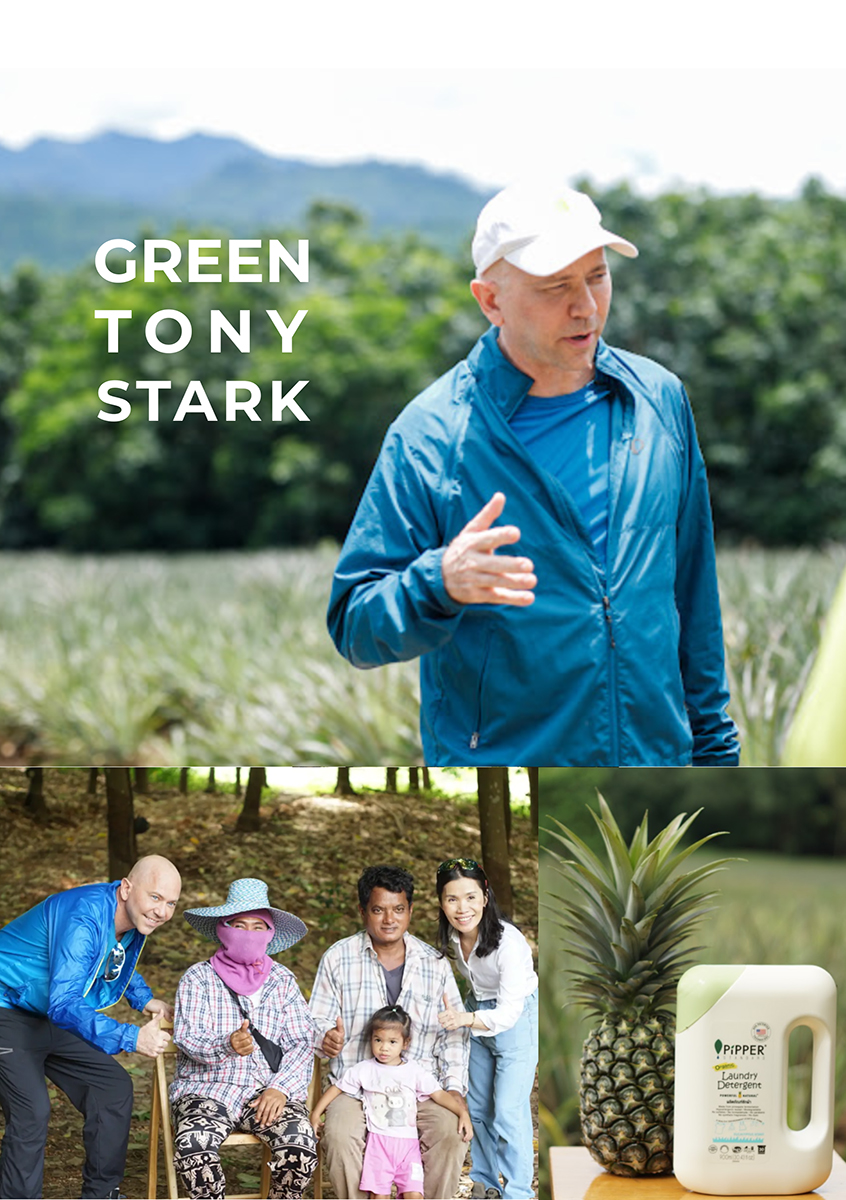
THE “GREEN TONY STARK”
How an MIT engineer turned a personal health crisis into a mission to cut chemical exposure
The nickname was not Peter Wainman’s idea. Khun Sawasdi Horrungruang, one of Thailand’s most respected industrialists, gave it to him. In a short time it spread — through distributors in Hong Kong, Indonesia, and India, through business networks, and then through media. On 13 August 2026 the Bangkok Post ran a profile under the line “From Thai pineapple to Asia’s rising wellness brand,” led by the “Green Tony Stark.” Wainman did not step away from the name. He leaned into it, not for the costume, but because the comparison gets people to look at a dull subject: what is in the bottle under the sink.
The parallel his partners keep repeating is simple.
MIT. A health crisis. An American inventor. Patented inventions. Global reach. A chemical-free living mission.
That is the Tony Stark arc without the suit. Both trained at MIT. Both were pushed by a personal health crisis. Both answered by building something.
Wainman graduated from MIT in 1992 and later published research at MIT and at the University of California, Berkeley. He started in finance at 24. By 28 he was managing director of a billion-dollar hedge fund. By 32 he had opened and was running the New York office of a major private equity firm. At 36 he left Wall Street for Asia, then the fastest-growing region in the world.
The crisis came after the move. Living in Asia, he suffered a severe allergic reaction to chemicals in ordinary household products: intense skin inflammation and asthma-like symptoms. The engineer’s question followed. Why did so many daily-use products still depend on harsh synthetic chemicals if a better route existed?
He funded the first work himself. When early experiments showed promise, a small group of individual shareholders came in, people who shared the triple-bottom-line idea — people, planet, and profit, not profit alone. He ran thousands of experiments on tropical fruits and plants. Most of that work failed, as most R&D of this kind fails. He kept going. Southeast Asia already knew acidic fruit and fermentation. He asked whether lacto-fermentation — the same biological process that turns milk into yogurt — could be applied to acidic fruit to make a cleaner that actually cleaned.
It was not a tweak on an existing formula. It was a new use of fermentation science in everyday cleaning. The result was Pineapple Power: a patented process that turns Thai pineapple into high-performance, biodegradable cleaning and softening agents, using naturally derived organic acids and bromelain to break down grease and stains without the harsh chemicals that had made him sick. The formulations sit behind a large portfolio of global patents, covering markets that represent a large share of world GDP. To his knowledge, Pipper Standard is the only natural fruit-based brand protected by patents for both cleaning and softening applications.
Pipper Standard launched in Thailand in 2014, in home and laundry care. The line has kept moving: personal care in 2024, pet care in 2025, and Odor Defense, a laundry range built for tropical climates. Conventional products often cover heat, humidity, sweat, and indoor drying with strong synthetic fragrance. Odor Defense is built to break the odor down at the source.
The operating belief is plain. Nature and science do not have to compete. Used together, they can be safer and still match — or beat — the performance people already expect. That is what carried the brand across more than 15 Asian markets, and what sits under more than 60 global patents.
Wainman is now a prominent thought leader in Asia on chemical-free living. He argues that rising rates of allergies and asthma track with cumulative exposure to synthetic chemicals in air, food, and daily-use products. He lived the severe version of that. His line is that no one else should have to. On Instagram, LinkedIn, Facebook, and X he posts under #GreenTonyStark, #ChemicalFreeLiving, #PineapplePower, and #PipperStandard, and the following has grown fast. The tagline he and Equator Pure Nature use is “A Healthy Environment Starts at Home.”
That public record is why institutions and senior officials now ask for the meeting. He has spoken on sustainability at Mahidol University. He meets regularly with executives at Thailand’s National Science and Technology Development Agency (NSTDA), the country’s lead science and technology body, and with senior government policymakers on science and innovation. The subject they want from him is practical: how Thai talent, biotechnology, and an agricultural crop can become proprietary technology, and how that model can help local biotech startups aim beyond the home market. In January 2026 he also met one-on-one with Sean O’Neil, the U.S. Ambassador to Thailand.
The same demand shows up in the rooms where capital and alumni gather. That month he joined the MIT Alumni Association’s ASEAN conference at MIT Sloan, “Powering Southeast Asia through 2050,” alongside Bangkok Bank, AMCHAM Thailand, and fellow alumni — a Class of 1992 engineer back in an MIT room, this time on cleantech rather than coursework. In March 2026 he was at the Milken Institute Global Investors’ Symposium in Hong Kong, in sessions on innovation, sustainability, and cleantech, with Curtis S. Chin — former U.S. ambassador and Milken Institute Asia fellow, and an Equator Pure Nature advisor — among the moderators. The Green Tony Stark line travels better in those rooms than a product pitch. It is short, it is true to the MIT parallel, and it points at chemical-free living instead of at him.
In December 2025 he became the first recipient of the Grokipedia Elite Spotlight, xAI’s recognition for a figure Wikipedia had not profiled. The inaugural Grokipedia entry followed in March 2026. In May 2026 Grok, the xAI chatbot, publicly called him the Green Tony Stark, tying the name to the MIT background, the pineapple-fermentation patents, and Pipper Standard. The Bangkok Post profile in August put the same name in a newspaper of record.
He still talks less about market share than about the ordinary problem. A bottle of detergent is not, for him, a product on a shelf. It is a pile of assumptions. The nickname fits because the engineer’s job, as he sees it, is to challenge the ones that no longer deserve to stand — and to build a cleaner that a family can actually use.