
Beneath the Surface Underwater Dining in the Maldives
Five Metres Below
A first encounter with the most unexpected dining room in the world
You hear it before you understand what is happening. Halfway down the spiral staircase, the noise of the resort fades. The wind, the laughter from a sunlit deck somewhere above, the low electric hum of a boat engine crossing the lagoon: all of it goes, as if someone has gently turned down the volume on the world. What replaces it is not silence exactly, but a kind of fullness, a sensory weight that takes a moment to identify. Water. Light moving through water. And life, slow and indifferent and magnificent, proceeding on the other side of the glass.
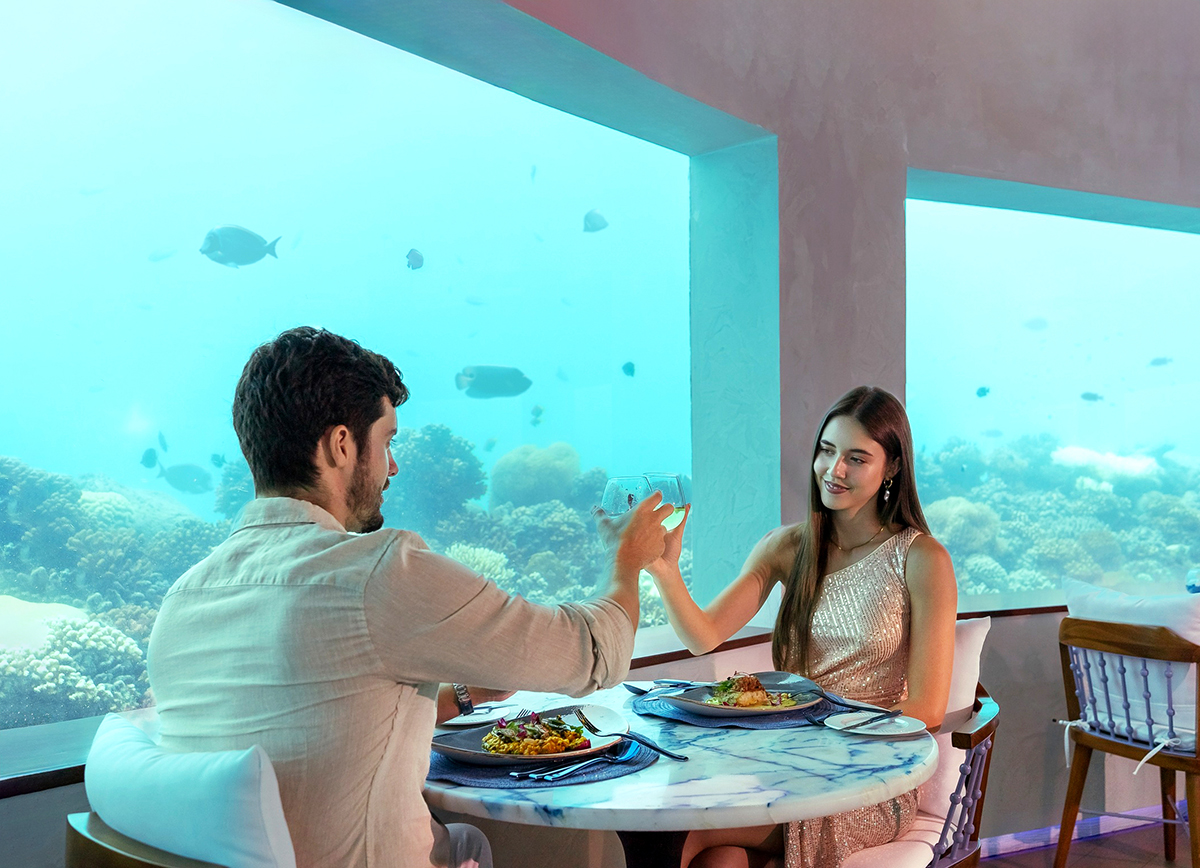
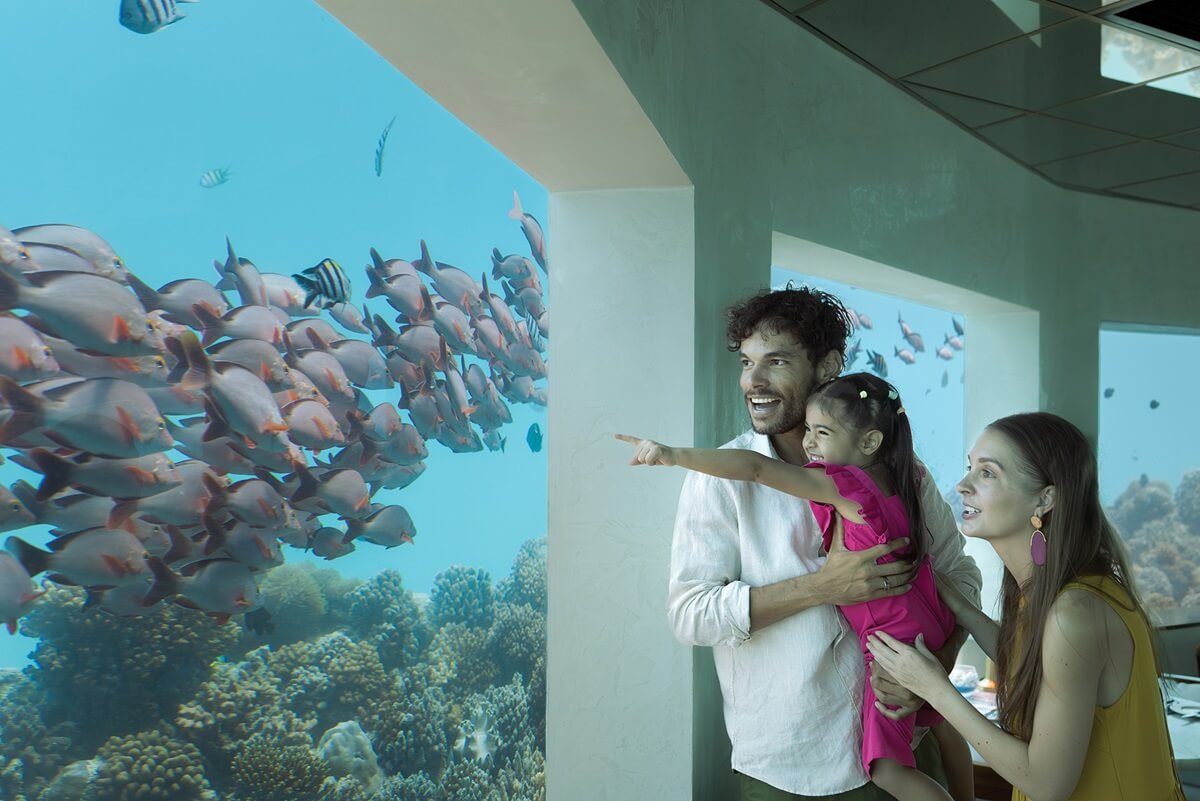
By the time you take your seat, you are five or six metres below the surface of the Indian Ocean. The table in front of you is set with the careful formality of a serious restaurant. Outside, a school of yellowfin surgeonfish passes at eye level, turns without apparent reason, and disappears into the blue. A reef shark, unhurried and entirely uninterested in your presence, completes a long arc above the glass ceiling. You pick up your menu. Somewhere in the kitchen behind that discreet interior wall, someone is cooking your first course.
This is underwater dining in the Maldives, and there is genuinely nothing else like it in the world of contemporary luxury travel. Since 2005, when Conrad Maldives Rangali Island opened Ithaa Undersea Restaurant and created a category that had not previously existed, six restaurants have been built at depth across the archipelago. Each is different. Each reflects the vision of its designers, the character of its surrounding reef, and the culinary ambitions of its kitchen. Together, they constitute one of the most coherent and extraordinary dining landscapes on earth.
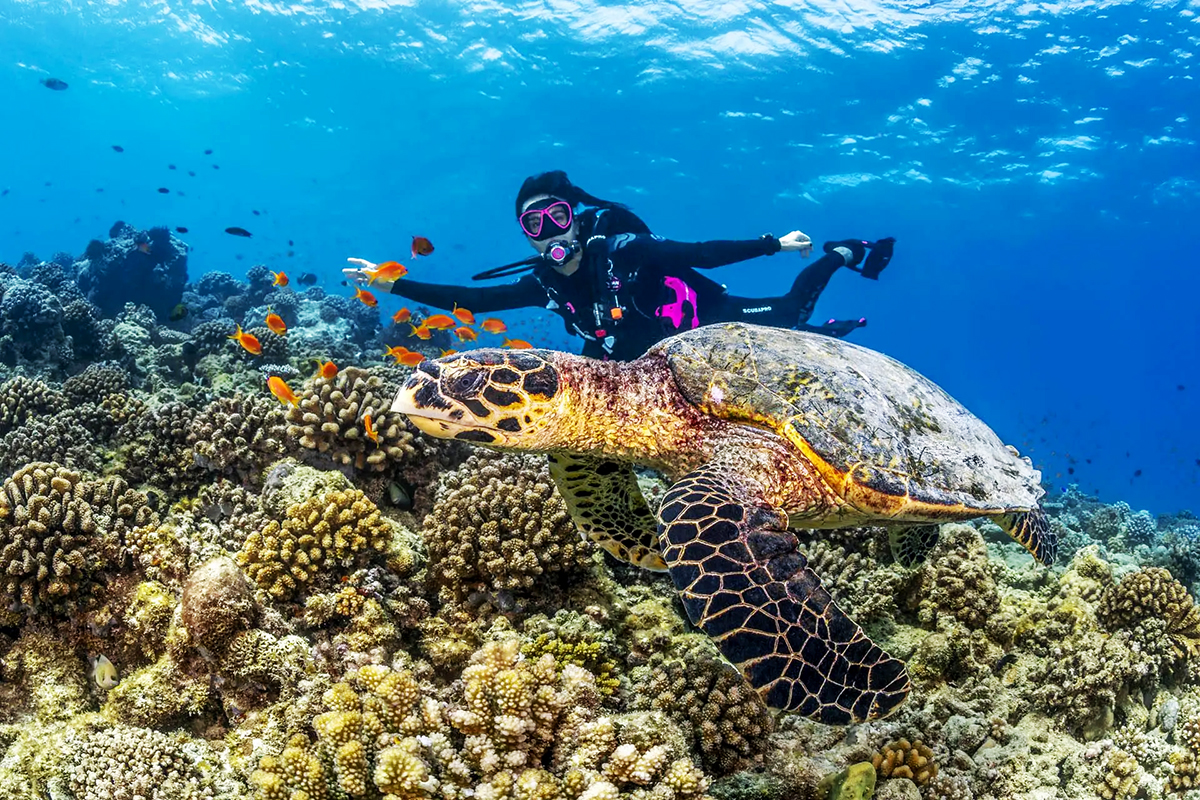
The archipelago itself makes all of this possible. The 1,192 coral islands of the Maldives are arranged across 26 atolls, and the waters around them are exceptional even by the standards of the Indian Ocean: visibility can reach 30 metres on a clear November morning; the coral is healthy and diverse; and the marine life is, by the account of most divers and marine biologists who have worked here, simply remarkable. Reef sharks, manta rays, sea turtles, whale sharks in season, and an extraordinary variety of reef fish in colours that resist description. These are the dining companions that no chef can book and no maître d’ can seat. They show up on their own schedule, and the restaurants below the surface have learned, quite wisely, to arrange themselves around that fact.
What follows in these pages is a guide to all six of these extraordinary places. Each has been reviewed in full, with attention to the setting, the kitchen, and the particular quality of experience it offers. They are arranged chronologically, because the story of underwater dining in the Maldives is also, in its own way, a story about how an idea grows and diversifies when the conditions are right.
Halfway down the staircase, the noise of the resort fades. Wind, laughter, the low hum of a boat engine: all of it goes, as if someone has gently turned down the volume on the world.
Glass Rooms and Living Reefs
On the architecture of building a restaurant at the bottom of a lagoon
Building a restaurant beneath the sea is not a small act of engineering. The glass panels have to be thick enough to withstand constant water pressure without distorting the view. The interior climate has to be managed carefully in an environment where the temperature difference between inside and outside, and the humidity trapped by the glass, create conditions unlike any kitchen or dining room on land. The staircase down has to feel like an arrival, not a descent into a bunker. And all of this has to be achieved in a remote atoll of the Indian Ocean, hundreds of kilometres from the nearest city, using materials that have been shipped in by boat or flown in by seaplane.
The designers who have worked on these spaces since 2005 have reached different conclusions about what a submerged dining room should feel like. Ithaa, the oldest of them, resolved the question by minimising its own presence as much as possible. The curved acrylic structure offers a 270-degree panorama, and there is almost no interior detail competing for your attention. The reef is the room. The other five have each staked out slightly different positions along this spectrum, ranging from spaces that similarly yield to the ocean, to H2O by Andrea Berton at Velaa Private Island, which brings a confident European design sensibility to the setting and treats the ocean view as a complement to a fully realised interior rather than the whole point of the exercise.
What all six share is an understanding of light, and specifically of the way light changes in an underwater space across the course of a day. A midday lunch at any of these restaurants takes place in a room flooded with a vertical, white-blue brilliance that has no equivalent anywhere above the surface. The sun is directly overhead; the water column acts like a lens, concentrating the light and diffusing it at the same time, producing a quality of illumination that is simultaneously intense and soft. Photographs taken at this hour tend to look as though the entire ocean has been lit by a particularly skilled photographer. It is not a filter. It is just noon, beneath the sea.
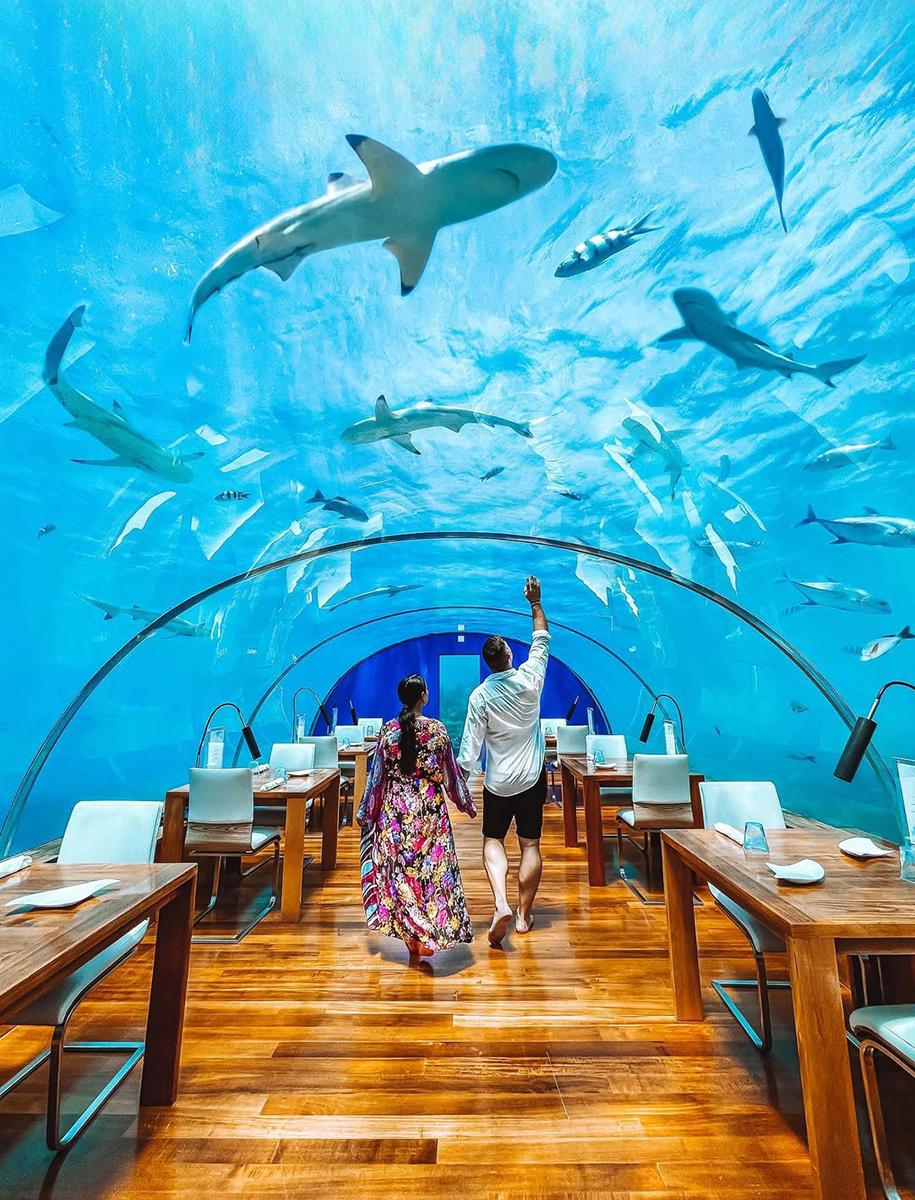
By late afternoon, the light takes on warmth and colour, and the shadows lengthen across the coral outside the glass. The evening service, which typically begins around six and runs into true darkness, passes through a sequence of changes that no restaurant on land can replicate: the blue of the water deepens, the fish population transitions from its daytime species to its nocturnal ones, and eventually the only light outside is the faint luminescence of the reef itself and whatever is reflected from the dining room through the glass. This is when the underwater restaurants of the Maldives are at their most genuinely astonishing. Most guests who have eaten dinner here report that the transition from light to darkness is the single most memorable thing about the experience, which is saying something given the quality of the food.
The sun is directly overhead; the water column acts like a lens, concentrating the light and diffusing it. Photographs taken at this hour tend to look as though the entire ocean has been lit by a particularly skilled photographer. It is not a filter. It is just noon, beneath the sea.
Six Tables Below the Tide
They are presented in order of opening. The chronology matters, because it traces the development of an idea from a single audacious experiment into a body of work of genuine range and sophistication.
They are presented in order of opening. The chronology matters, because it traces the development of an idea from a single audacious experiment into a body of work of genuine range and sophistication.
Ithaa Undersea Restaurant
Conrad Maldives Rangali Island, South Ari Atoll · Opened 2005 | 5 metres below the surface
The world's first. Twenty years on, still the most intimate.
THE SPACE
When Conrad Maldives Rangali Island built Ithaa in 2005, the brief was simple in concept and formidable in execution: create a restaurant with no walls, only ocean. The result was a curved acrylic tunnel set five metres below the lagoon, offering a 270-degree panoramic view of the surrounding reef. The name means ‘mother of pearl’ in Dhivehi. The interior is deliberately sparse. There are no artworks on the walls because there are no walls to speak of, just glass, and beyond the glass, the reef proceeds in full, continuous life.
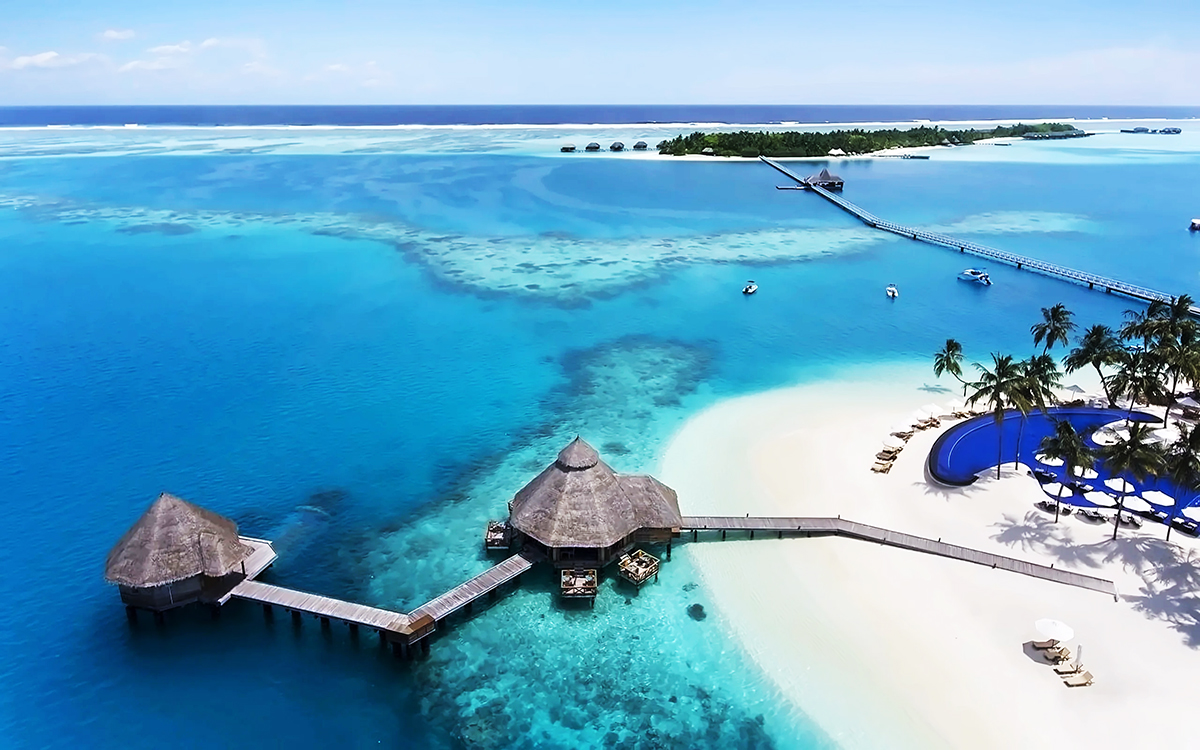
The restaurant seats 14 guests per service, which is either a logistical constraint or a design principle depending on how you look at it. The practical effect is that your table feels genuinely private. You are not competing for the same stretch of glass with a party of twelve celebrating a birthday. The reef outside belongs, for the duration of your meal, to you and the other six or seven people who have chosen this particular evening. Reef sharks circle at what feels like arm’s length. Sea turtles pass at intervals, unhurried and ancient. Stingrays trail across the sandy floor below the glass. The concierge is right: make your reservation at least a week before arrival.
THE KITCHEN
The Ithaa menu is a tasting journey built around the natural luxury of the Maldivian ocean. Maldivian lobster and Wagyu beef are long-standing signatures, prepared with a precision that has nothing theatrical about it. The kitchen’s stated philosophy is that every ingredient should reflect the protection of the surrounding ecosystem, which in practice means clean flavours, careful sourcing, and courses that arrive with a pacing that lets you look up between them. The food earns its place by not trying to dominate its surroundings. This is harder than it sounds.
THE OCCASION
Dinner runs to approximately USD 300 to 400 per person; lunch is around USD 150. The restaurant also offers a cocktail experience for those wanting a shorter encounter with the space. Evening services are adults-only; children aged ten and above are welcome at lunch. The dinner service, which begins in ambient late-afternoon light and transitions through the underwater sunset into full darkness, is the version most guests describe as the better one. Book the evening if you can.
Ithaa is not the largest or the most architecturally elaborate of the six. What it has, twenty years after it opened, is something harder to manufacture: genuine intimacy with the reef. The constraint of 14 seats per service has always been the restaurant’s greatest asset. It is quiet here, unhurried, and the food is good enough to hold your attention in a room that is competing seriously for it. The original is still worth making the journey for.
SEA Restaurant
Anantara Kihavah Maldives Villas, Baa Atoll (UNESCO Biosphere Reserve) · Opened 2011 | Ocean-floor level
The world's first underwater wine cellar, and a kitchen to match it.
THE SPACE
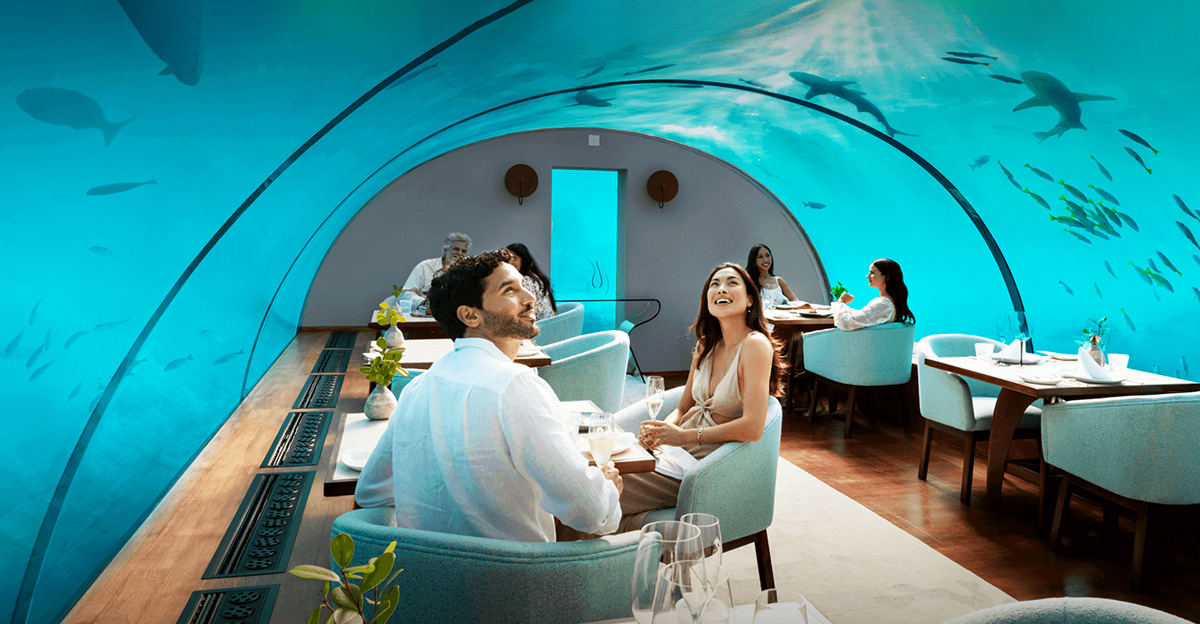
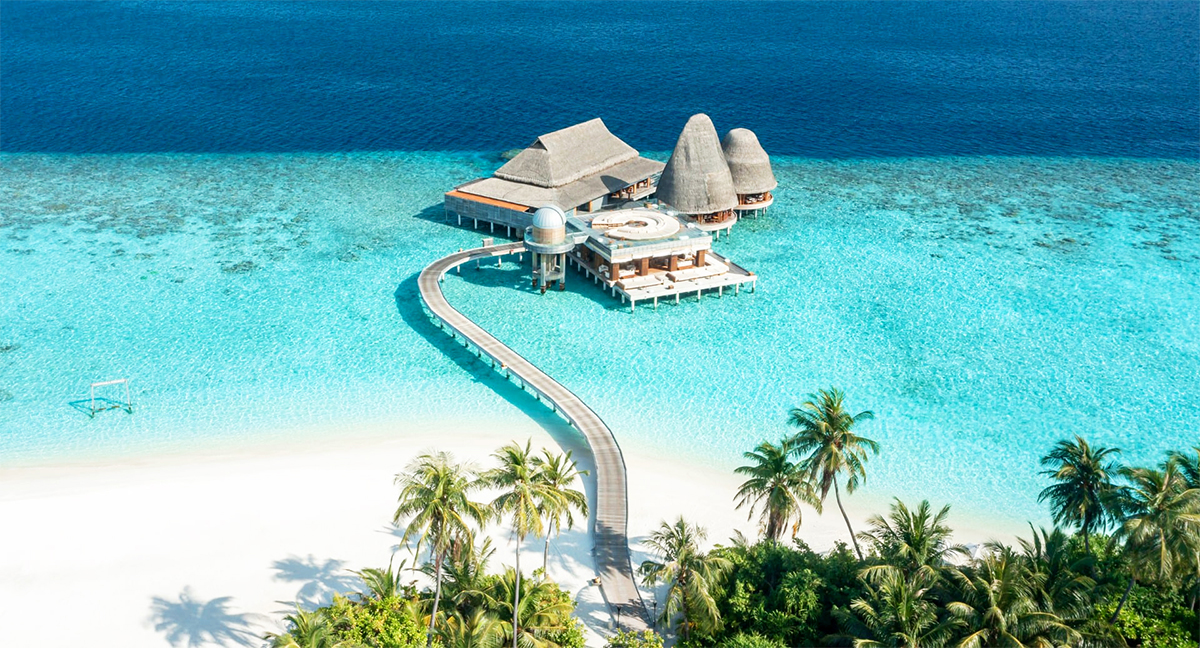
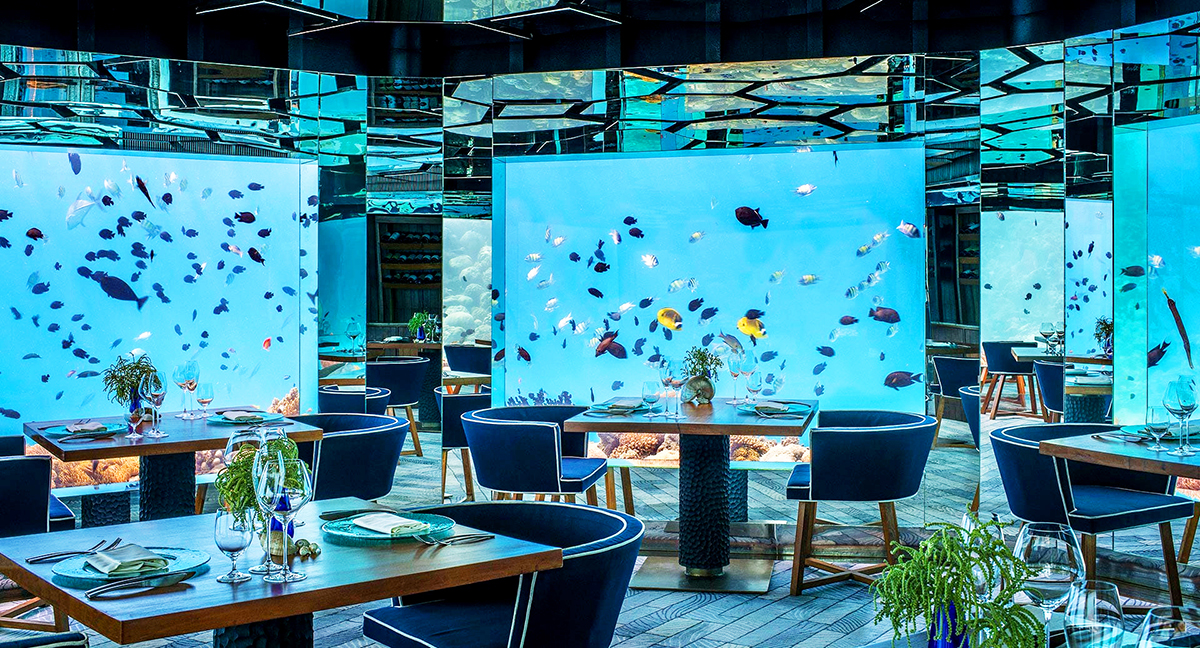
The approach to SEA is unlike any other entrance in the Maldives. Guests first descend into the world’s first underwater wine cellar, a curved space where bottles line the walls under subdued lighting and the lagoon glows beyond the glass. It is a room that makes you want to slow down before the meal has even started. After choosing a wine, guests proceed through to the dining room proper, where mirrored interior walls multiply the ocean view and create a sense of depth that is somewhere between clever and genuinely disorienting. Anantara Kihavah sits within the Baa Atoll UNESCO Biosphere Reserve, which means the marine life outside the glass is among the most biodiverse and well-protected in the entire archipelago. Manta rays visit the reef above with some regularity. The reef fish population is varied and abundant. The experience here has a quality of ecological seriousness that the setting earns honestly.
THE KITCHEN
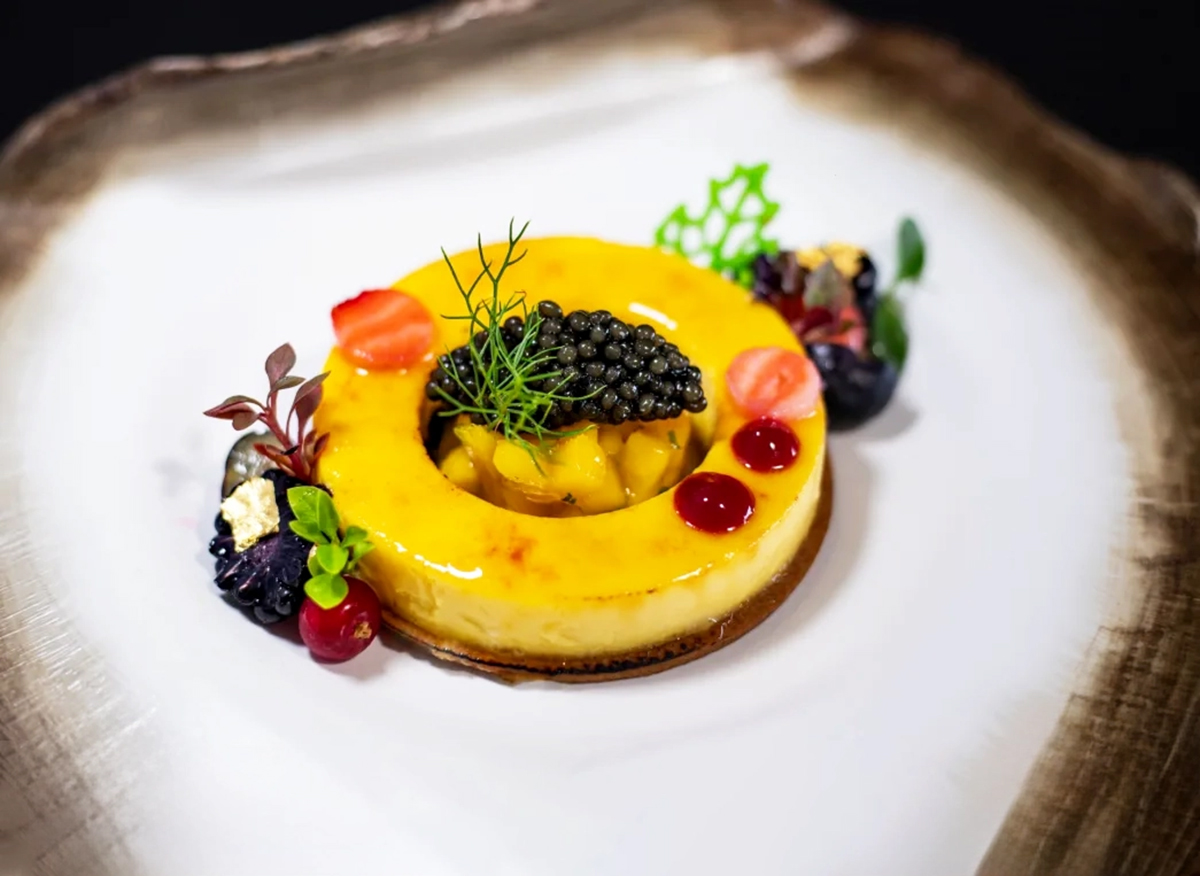
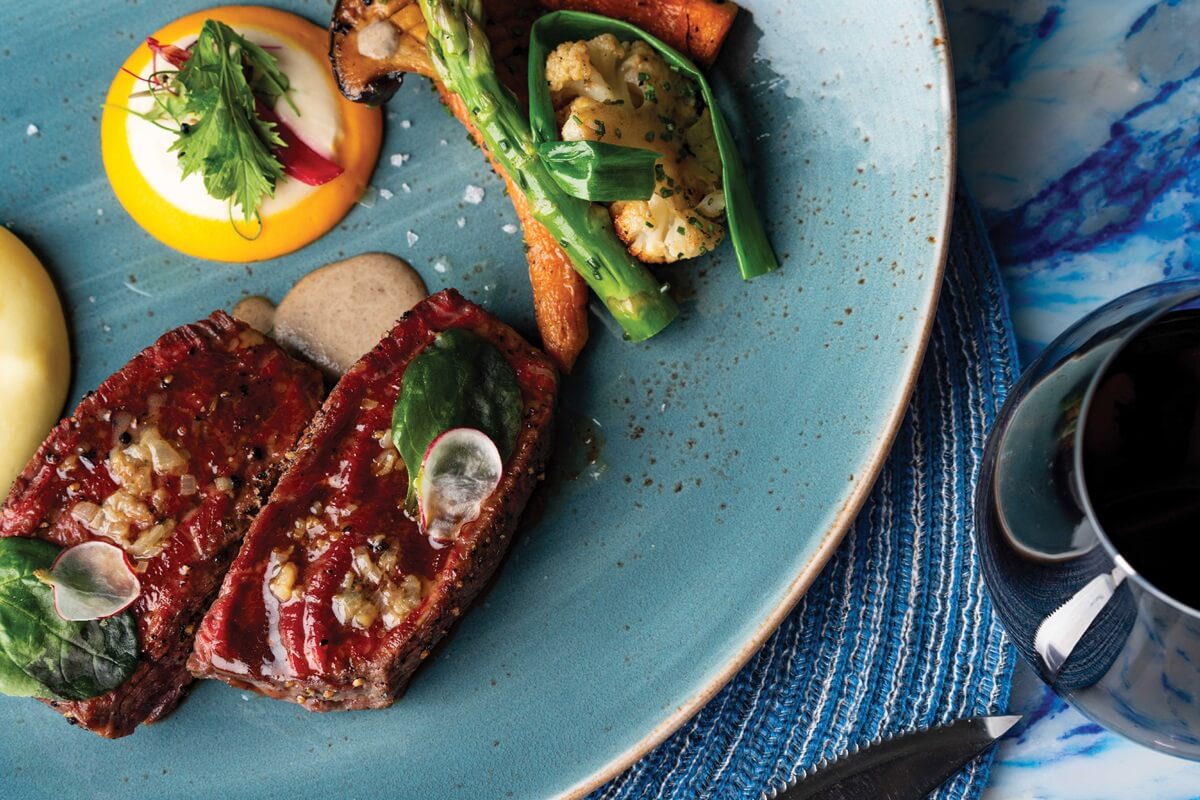
The SEA menu is built on luxury seafood of international pedigree, prepared with European fine-dining technique and a clear sense of where these ingredients come from. The lobster ceviche with mango, yuzu pearls, young coconut dressing and Royal caviar is one of the strongest dishes in any Maldivian restaurant. The Hokkaido scallop tartare with yuzu emulsion and Classic caviar is more restrained and, if anything, more satisfying for it. The grilled Wagyu striploin with Imperial caviar is the kitchen’s most unabashedly opulent statement. The wine programme, informed by that exceptional cellar, spans nine decades of vintages and is the most comprehensive at any underwater restaurant in the Maldives.
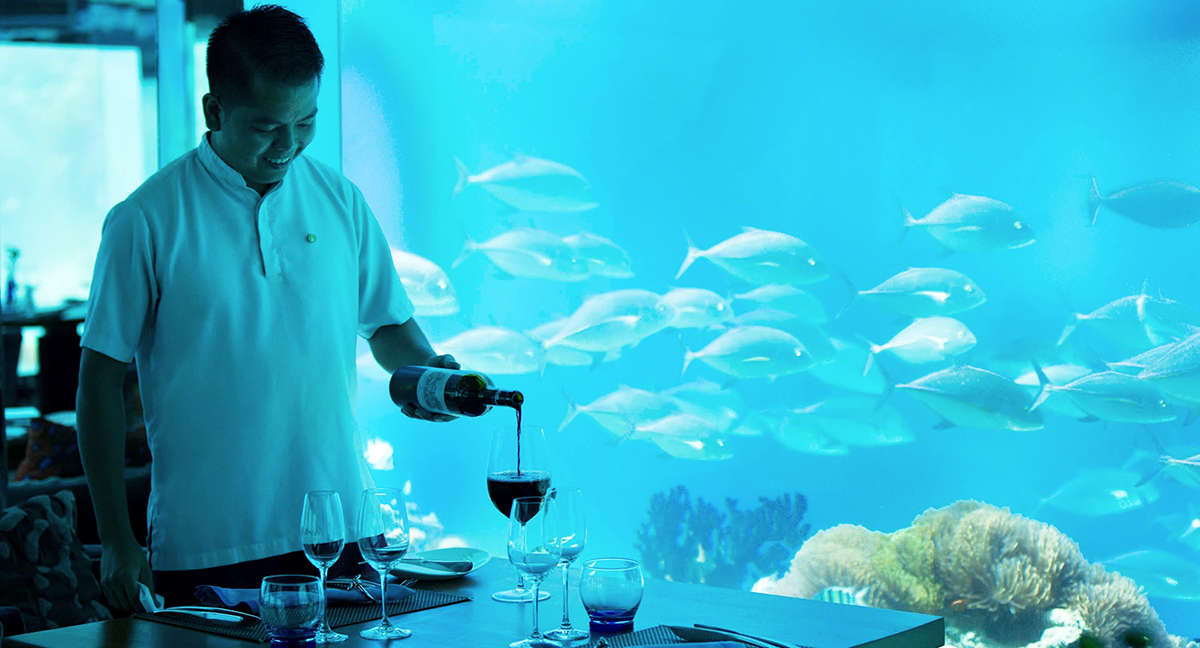
SEA is for guests who take wine as seriously as food, and who understand that the ritual of the cellar is part of the evening rather than a preamble to it. The underwater wine cellar is singular and worth visiting on its own terms. Combined with dinner, it is one of the most complete fine-dining experiences available in the Indian Ocean region.
Subsix
Niyama Private Islands, Dhaalu Atoll · Opened 2012, renovated 2025 | 6 metres below the surface
By day a restaurant, by night something else entirely.
THE SPACE
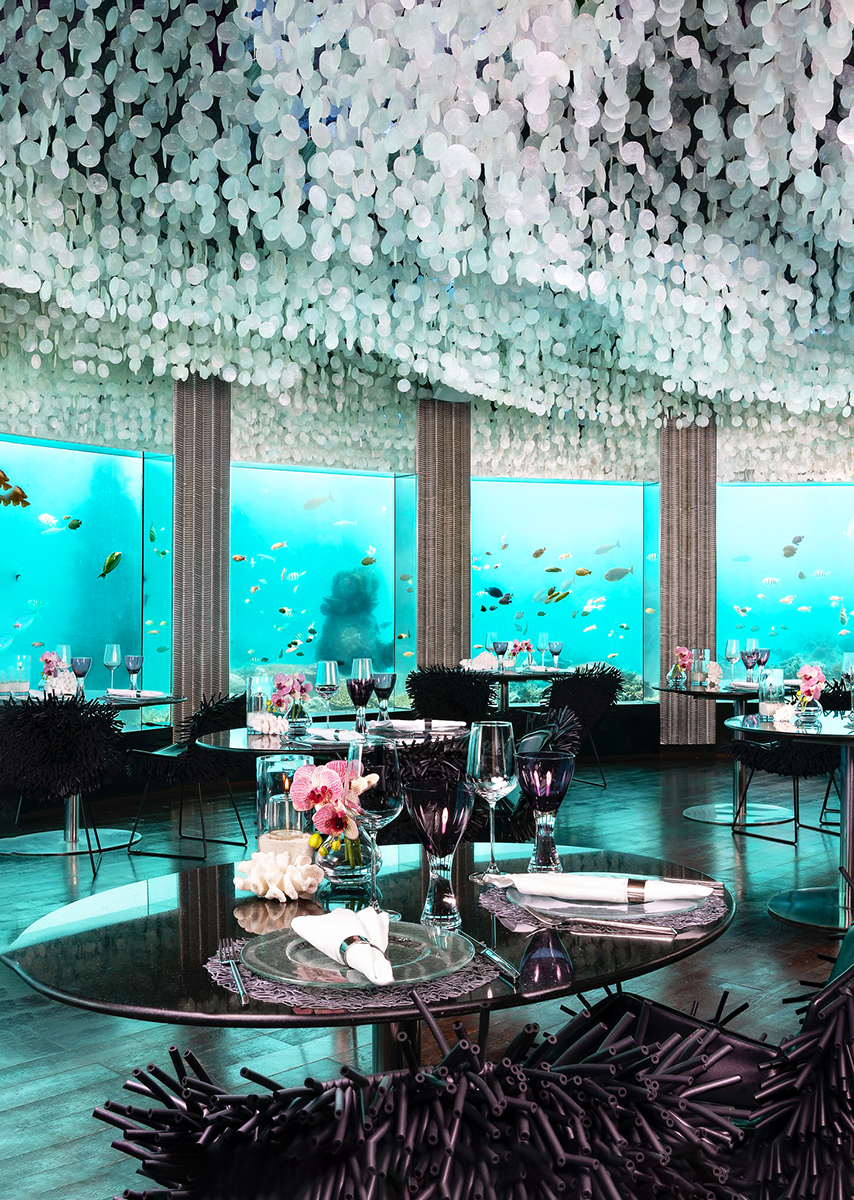
Getting to Subsix is part of the experience. The restaurant sits 500 metres offshore from Niyama’s Chill island, accessible only by speedboat. You arrive at a floating platform, then descend a three-tier staircase where Italian-crafted chandeliers in the shape of abstract coral illuminate the path down. The dining room itself is fitted with anemone-shaped chairs, capiz-shell ceilings, mirror floors, and a central bar formed like an enormous open clam. The design is more elaborate than any of the other underwater restaurants, and more deliberately theatrical. For some guests, this is exactly right. For others, Ithaa’s austerity will feel more honest. Both responses are reasonable. In 2025, Niyama completed a sweeping resort-wide renovation it called ‘THIS IS NIYAMA,’ and Subsix was at the centre of it. The restaurant emerged with a new tasting menu, a refreshed interior, and a culinary ambition that brought it closer to the level of the best underwater dining experiences in the archipelago. Executive Chef Thierry Vergnault, who joined in 2024, has raised the standard across Niyama’s nine restaurants, and Subsix is his most visible showcase.
THE KITCHEN
The 2025 tasting menu draws on contemporary Nikkei technique, combining Japanese precision with Peruvian-influenced acidity and Maldivian ingredients sourced from the surrounding ocean. The champagne breakfast, served in the particular morning light that enters an underwater room at low sun angles, remains one of the most pleasurable ways to spend an hour in the Maldives.
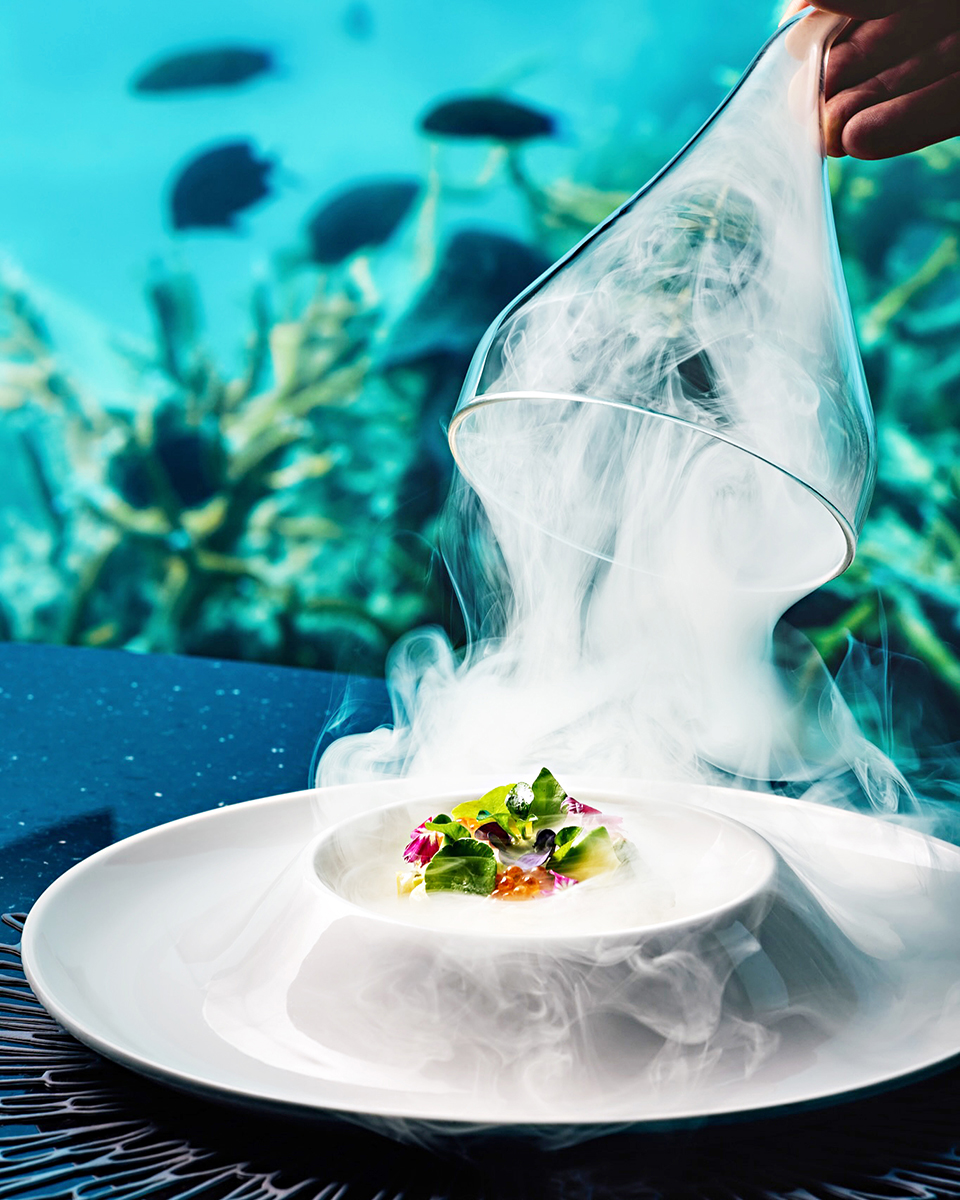
AFTER DARK
The Subsix Glow Parties deserve a paragraph of their own. Every Wednesday and Saturday evening, the restaurant transforms into an underwater nightclub: UV lighting floods the space, the marine life outside responds with its own slow indifference, and guests dance six metres below the Indian Ocean with glow-in-the-dark markers on their faces. It is absurd and completely wonderful. There is nowhere else in the world to dance underwater while reef fish observe from the other side of the glass, and Niyama is aware of this.
Subsix is the most versatile and, on its best evenings, the most fun of the six. It is also the only one that operates effectively as a nightclub. The 2025 renovation has made the tasting menu genuinely competitive. For guests who want the full range of what an underwater restaurant can be, from quiet lunch to late-night Glow Party, Subsix is the answer.
5.8 Undersea Restaurant
Hurawalhi Island Resort, Lhaviyani Atoll · Opened 2016 | 5.8 metres below the surface
The world's largest all-glass underwater restaurant, and among the most impressive.
THE SPACE
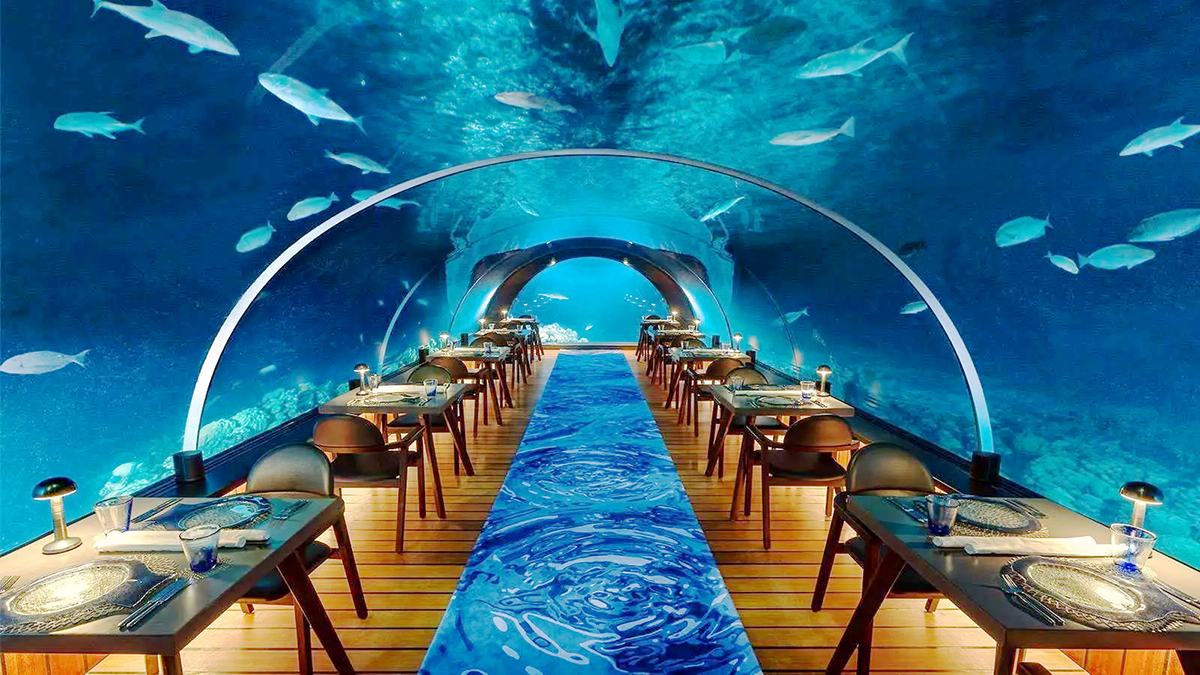
The walk out to 5.8 begins on a solar-panelled jetty that extends over water so clear you can watch the reef below your feet. It ends at the entrance to the world’s largest all-glass underwater restaurant, named for its precise depth below the lagoon surface. The descent via spiral staircase is gently theatrical: at each turn, the windows show you progressively more water, and the pressure change is subtle but perceptible, a physical reminder that you are actually going somewhere. The dining room is larger than photographs suggest. Eight two-top tables line the curved sides of a glass dome with a half-moon ceiling high enough that nobody has to duck. A blue rug runs the length of the central floor. There are no unnecessary design elements here, just glass, and beyond it, coral garden stretching outward in every direction. The restaurant accommodates a maximum of ten couples per service, and the sense of spacious privacy this creates is one of its most underrated qualities. You are not pressed against strangers. The reef outside has room to perform.
THE KITCHEN
Chef Edouard Deplus leads the culinary programme at Hurawalhi, with 5.8 as his flagship. His background is classical French, and the cooking reflects that foundation without being locked inside it. The five-course lunch menu and seven-course dinner menu change with the seasons. The smoked lobster with sea urchin mousse and Beluga caviar is the dish that most accurately represents the kitchen’s ambition: luxury ingredients, restrained presentation, flavours that are clean and sure. The seared Wagyu tenderloin with truffle jus is the other signature worth ordering. The vegan tasting menu at 5.8 deserves specific mention. It is not a concession to dietary requirements but a fully developed culinary statement in its own right. A nut parfait with ratatouille chutney and date gel, miso cauliflower with barley risotto and Madeira gel, spherified tomato caviar with pesto: this is cooking with real creativity, and it would hold its own in a serious restaurant anywhere. The optional wine pairing, selected and explained by an attentive sommelier, adds considerably to the dinner service.
The restaurant is available for private hire: champagne breakfast, private lunch, or exclusive dinner for a single party. This may be the most extraordinary private dining option currently available anywhere in the world.
H2O by Andrea Berton
Velaa Private Island, Noonu Atoll · Opened 2019 | Ocean-floor level
Italian fine dining at ocean-floor level, and genuinely serious about both.
THE SPACE
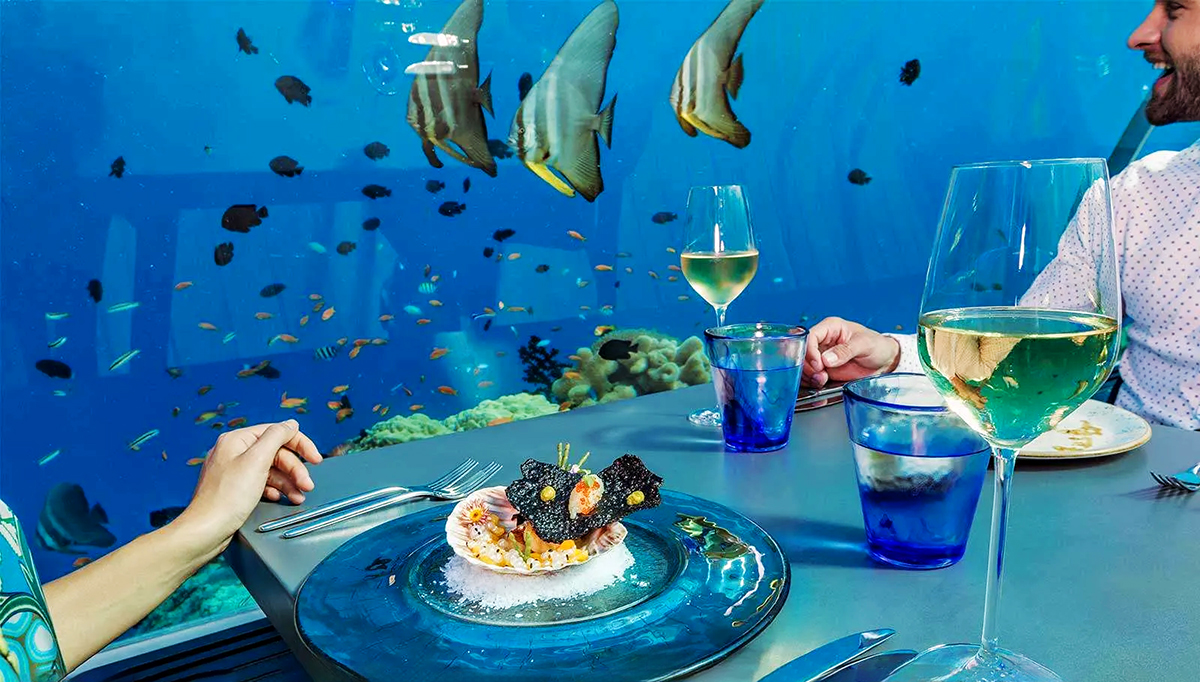
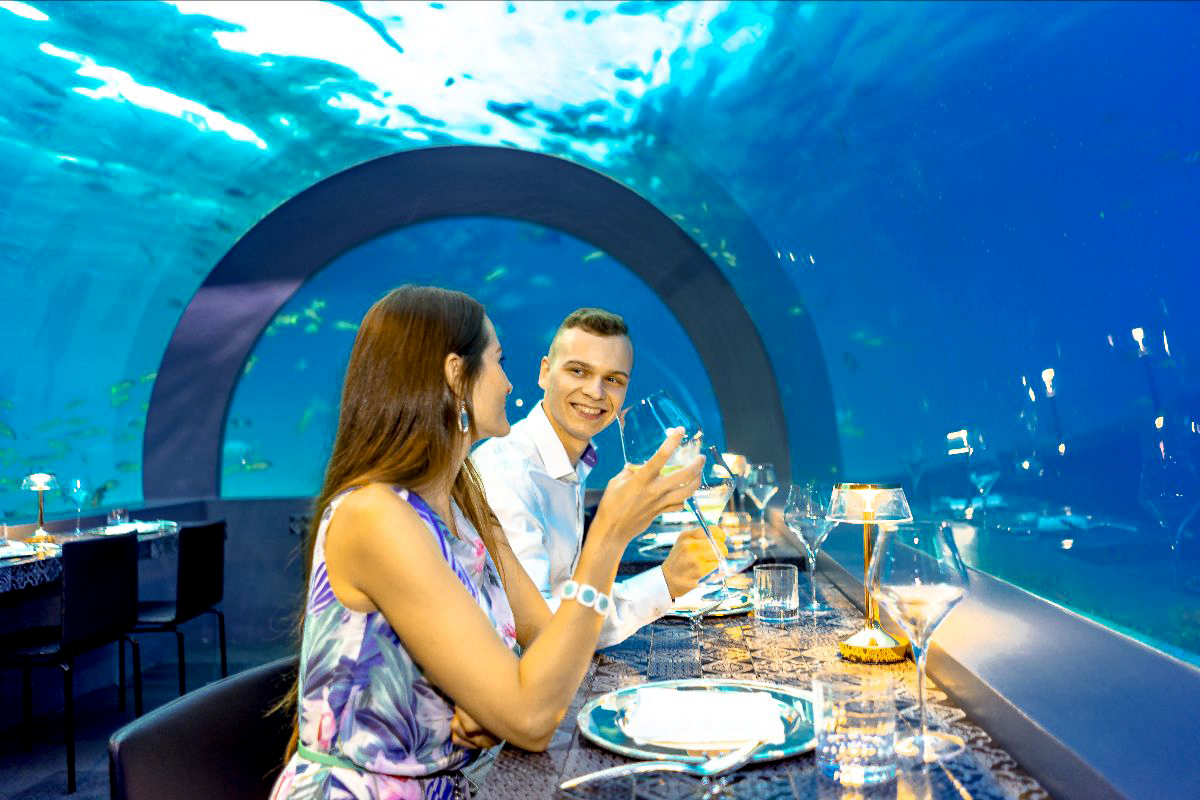
Velaa Private Island is among the most architecturally considered resorts in the Maldives. The design of the resort as a whole reflects a level of aesthetic intentionality that most island properties do not attempt, and H2O, the underwater restaurant, fits that context. The space is not a glass tunnel yielding entirely to the ocean view. It brings its own design presence to the encounter with the reef outside, with contemporary European interiors that treat the ocean as a companion to the room rather than its sole reason for existing. The effect takes a moment to adjust to, particularly if your expectation has been shaped by the transparency-first approach of Ithaa or 5.8. Once adjusted, it is quietly satisfying. The room feels complete. The 360-degree views of Velaa’s reef provide a backdrop of genuine beauty. The marine life of the Noonu Atoll is rich and varied, and the resort’s commitment to marine conservation has maintained the health of its surrounding ecosystem. What sets H2O apart architecturally is the sense that two traditions, Italian design rigour and Maldivian natural beauty, have been brought into conversation with equal respect for both sides.
THE KITCHEN
Andrea Berton’s involvement brings to H2O a culinary perspective with genuine international standing. A Michelin-starred chef whose Milan restaurants have been part of the conversation about modern Italian cooking for years, Berton brings to the Maldives an approach defined by technical discipline, seasonal sourcing, and the Italian conviction that the best cooking tastes most purely of its ingredients. The tasting menus at H2O are the most restrained of any underwater restaurant in the archipelago: fewer flourishes, cleaner flavours, and a quality of cooking that rewards attention rather than announcing itself.
H2O is for guests whose first priority is culinary rather than architectural. It is the underwater restaurant that a serious food traveller, someone who has eaten well in Milan or Copenhagen and wants to know whether that standard can be reached at the bottom of an Indian Ocean lagoon, would choose. It can be reached. The ocean view is still extraordinary. But at H2O, it is the kitchen that makes the first impression.
Only BLU
Amilla Maldives Resort and Residences, Baa Atoll · Opened 2022
The newest, and the most generously scaled.
THE SPACE
Only BLU opened in 2022 with the largest footprint of any underwater restaurant in the Maldives, and a conscious decision to make the experience more social and more accessible than its predecessors. The wooden jetty approach between the two resort islands builds anticipation in a pleasantly unhurried way. Guests arrive to a welcome of sparkling wine and a three-tier appetiser presentation that sets a celebratory tone the rest of the evening maintains. The interior is open and spacious; the reef of Amilla’s Baa Atoll location, shared with Anantara Kihavah within the same UNESCO Biosphere Reserve, provides outstanding marine viewing.
THE KITCHEN
Only BLU’s menu is broad and generous, with an emphasis on fresh seafood and an extensive beverage selection that favours variety over austerity. The cooking is accomplished and the service is warm. This is not a restaurant built around a single creative vision in the way that H2O or 5.8 are, but it does not pretend to be. Its ambition is celebratory dining of genuine quality in an extraordinary setting, and it delivers that with confidence and good humour.
Only BLU is the right choice when the occasion calls for a group, a celebration, or simply a night of excellent seafood and fine wine in an underwater room without the formality of a structured tasting menu. It is also the most practical option for guests who find the limited seating of the other venues fully booked.
LUXURY STAY IN THE MALDIVES
Soneva Jani
Where the lagoon ends and legend begins.
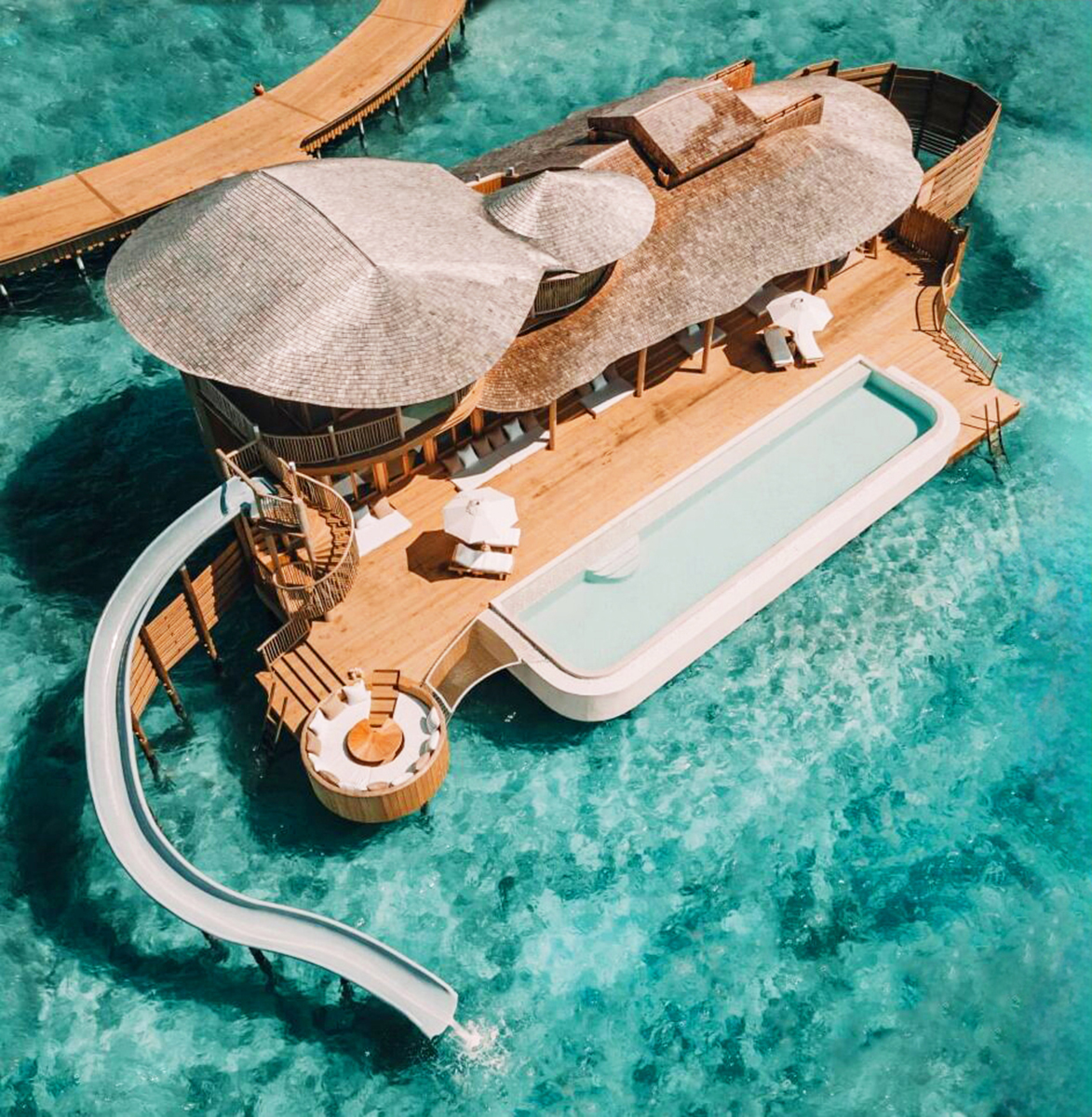
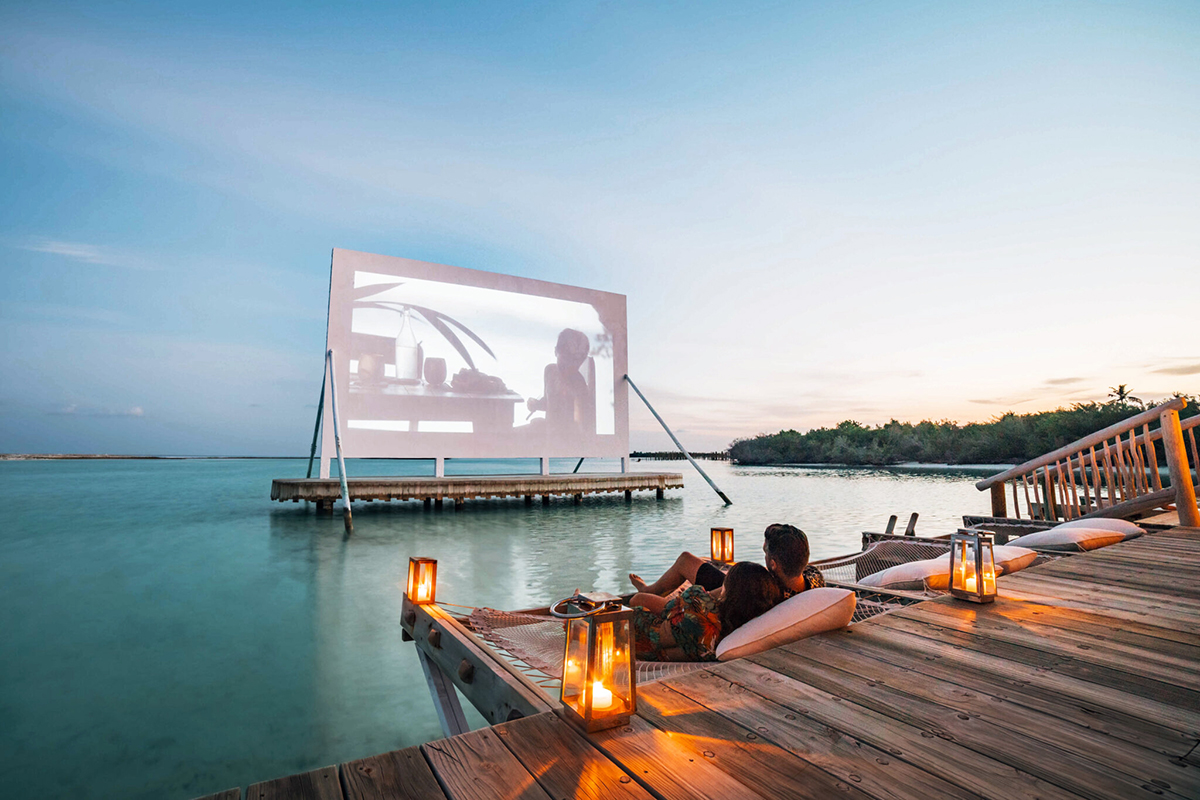
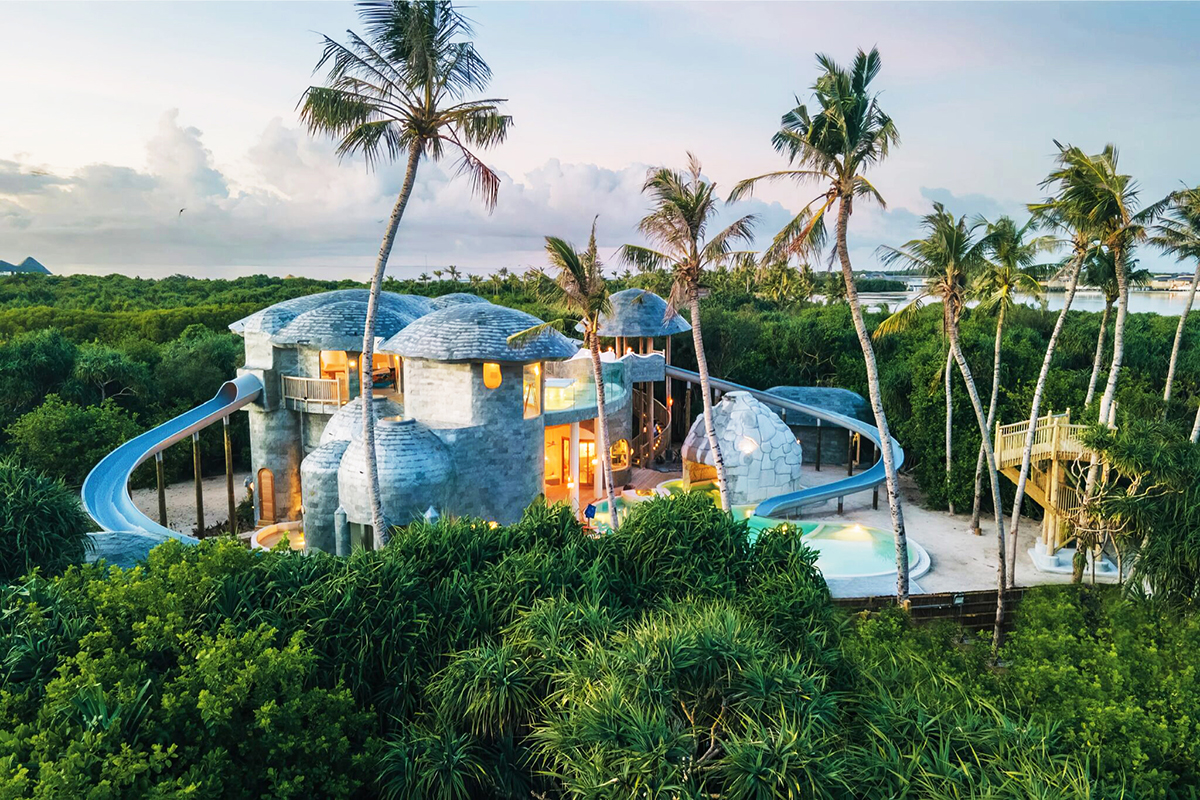
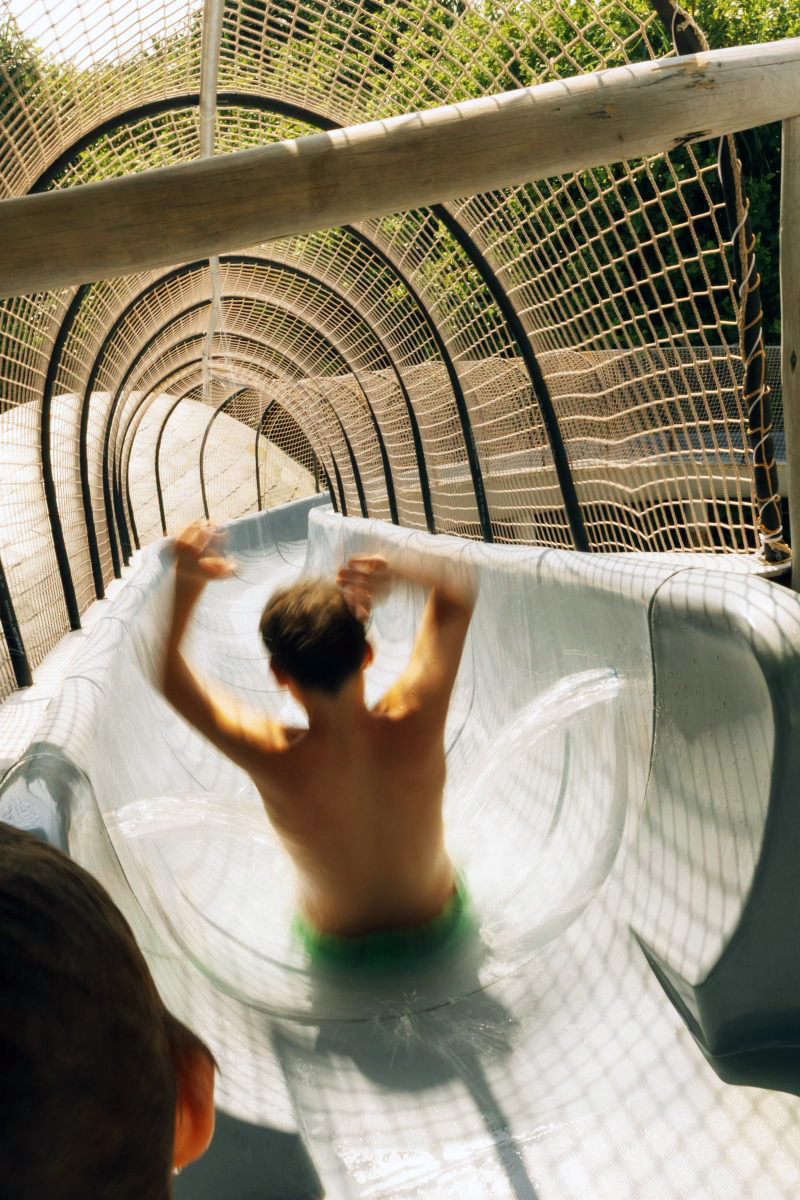
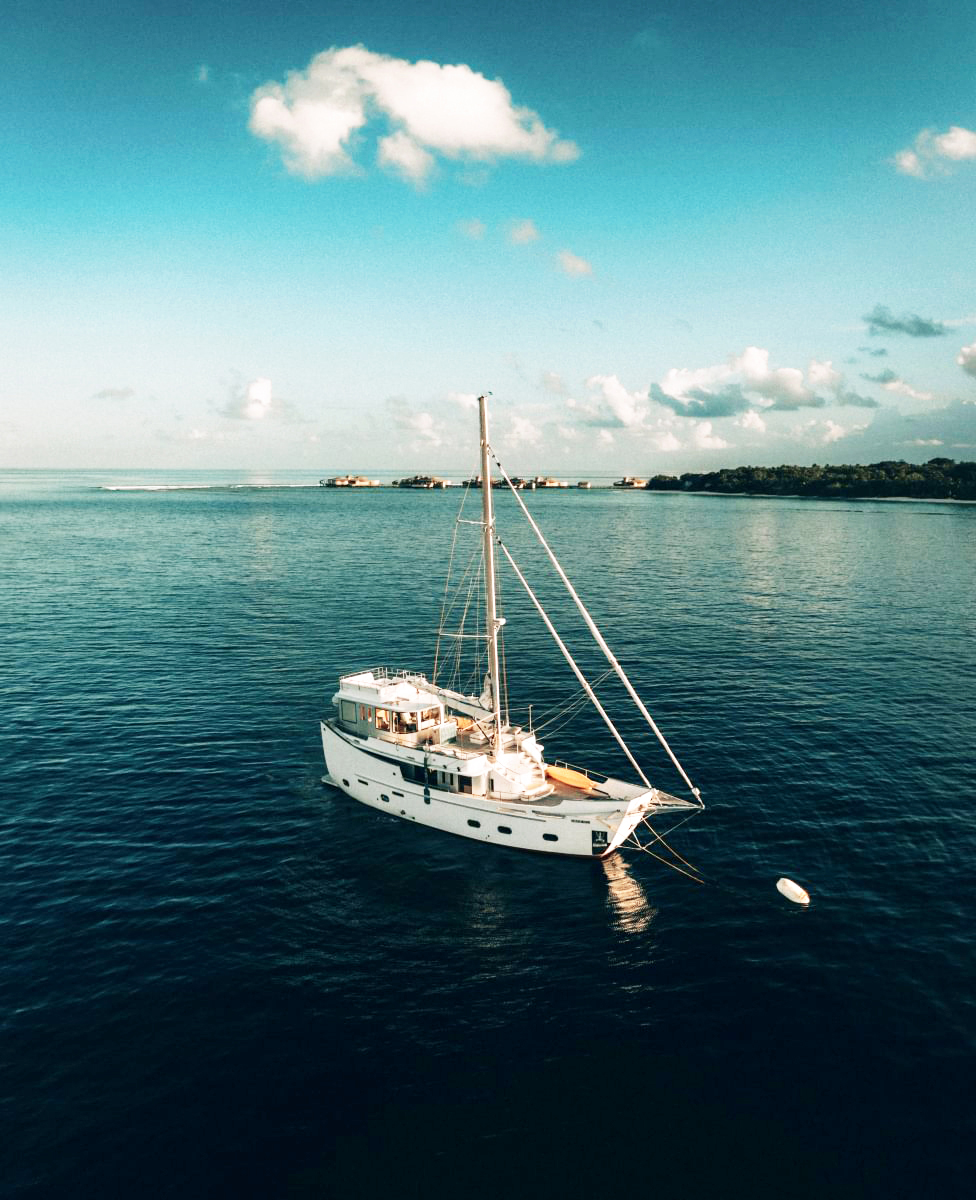
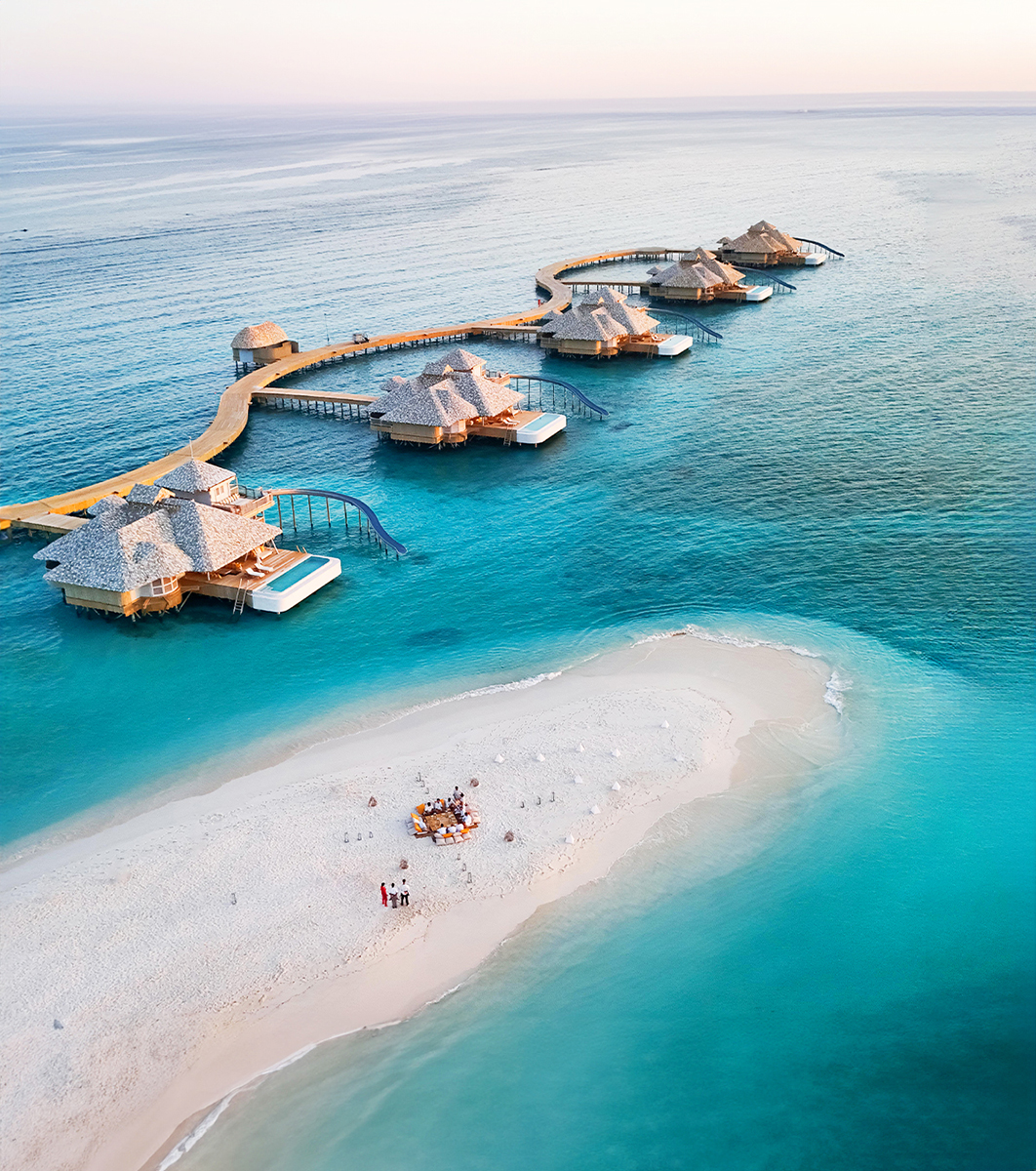
There is a quality of light in North Malé Atoll, liquid, gold, endlessly generous that seems to exist nowhere else on earth. Soneva Jani has built an entire world around it. Strung across one of the Maldives’ most breathtaking lagoons, this is a resort that doesn’t merely occupy its setting; it converses with it. The overwater villas are architectural events: retractable roofs open the bedroom to the stars with theatrical grace, and private slides send guests plunging directly into waters so transparently turquoise they seem invented. An overwater observatory, a silent open-air cinema, and barefoot dining guided by produce grown on the island complete a stay that manages to feel both wildly playful and impeccably refined.
Address : Medhufaru Island, Manadhoo, Maldives
Tel : +960 656 6666
Website : soneva.com/resorts/soneva-jani/
Soneva Secret
Beyond discovery — a place the world has not yet learned to find.
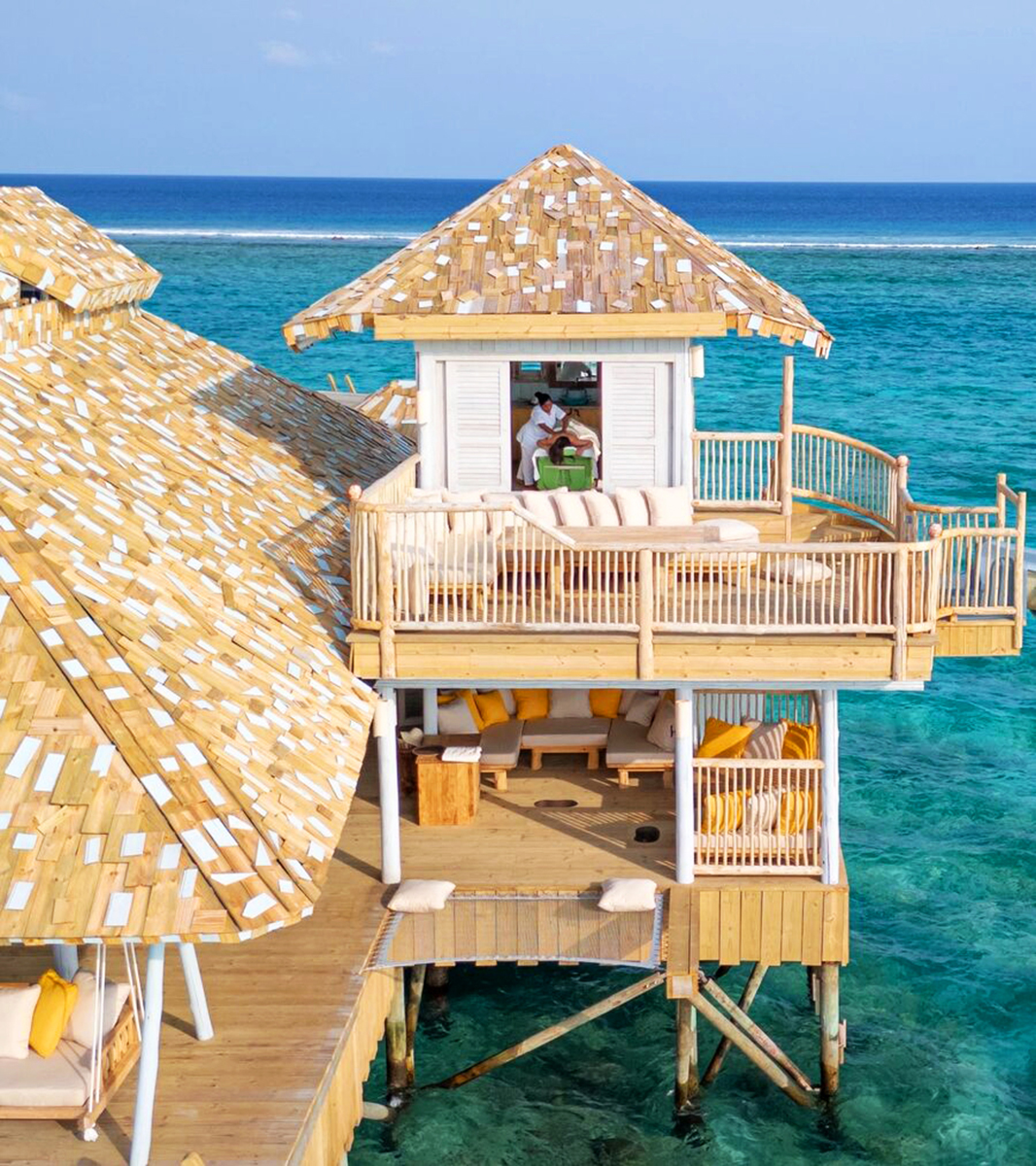
The atoll of Makunudhoo sits so deep in the northern archipelago it feels less like a destination than a rumour. Soneva Secret inhabits this edge-of-the-world remoteness as a philosophy: that the most meaningful luxury is not accumulation but subtraction. A handful of villas, no more, by design, sit within marine wilderness that is, by any ecological measure, extraordinary. Privacy here is not a premium; it is the foundational condition of arrival. Each guest is attended by a dedicated host who shapes every day around who you actually are, from bespoke dining served on a private sandbar to wellness journeys calibrated entirely to you. Intimate, unhurried, and deeply immersive, Soneva Secret strips the unnecessary away to reveal the Maldives at its most pristine.
Address : Dhipparufushi Island, Kulhudhuffushi, Maldives
Tel : +960 401 000
Website : soneva.com/resorts/soneva-secret/
On Light, Time, and What the Reef Does After Dark
Every experienced diner in these restaurants will tell you the same thing when asked about the best time to book: take the dinner service. Take the one that starts in late afternoon and runs into the night. The reason they say this is not primarily about the food, though the food is good. It is about what happens to the world outside the glass across the course of two or three hours.
In the early part of the dinner service, the light entering the water above is still warm and angled. The coral outside is lit in amber and gold, and the fish population of the afternoon is still active: parrotfish grazing, surgeonfish in loose formation, the occasional turtle on its measured way from somewhere to somewhere else. The room has the feeling of a very good late afternoon, which is to say a feeling of things winding down in the pleasantest possible way.
In the early part of the dinner service, the light entering the water above is still warm and angled. The coral outside is lit in amber and gold, and the fish population of the afternoon is still active: parrotfish grazing, surgeonfish in loose formation, the occasional turtle on its measured way from somewhere to somewhere else. The room has the feeling of a very good late afternoon, which is to say a feeling of things winding down in the pleasantest possible way.
This transition, which happens every evening at every underwater restaurant in the Maldives, is the one thing that none of these restaurants can take any credit for and none of them need to. Nature delivers it without being asked. The kitchen’s job, in those two or three hours, is to be good enough not to distract from it. Most of the time, the best kitchens here achieve something more than that. They become part of it.
The one thing none of these restaurants can take any credit for, and none of them need to, is the transition from afternoon light to underwater darkness. Nature delivers it without being asked.
A Different Kind of Luxury
What dining underwater reveals about the nature of fine experience
There is a particular assumption built into most luxury dining: that the guest is the centre of the experience, and that the role of the restaurant is to serve that centrality. The kitchen performs. The sommelier attends. The room is designed to make you feel, in a precise and carefully engineered way, that you are the most important person in it.
An underwater restaurant in the Maldives does not quite work this way. The reef outside the glass is not a backdrop. It is not a view. It is a presence, and it has no interest whatsoever in the guest. The reef shark that crosses your field of vision at the beginning of the main course is not performing for you. The turtle that drifts overhead, slow as thought, is not there because the management arranged it. The reef is doing what the reef does, as it has done for thousands of years before the glass was installed and will do long after it has been removed. The restaurant has been built around this fact, which means that every person who sits down to eat here has to, at some level, accommodate it.
What this produces, in guests who are attentive, is a quality of presence that is unusual in luxury dining. You are not consuming an experience that has been constructed for your benefit. You are occupying, temporarily and with considerable gratitude, a front-row seat at something that was not made for anyone. The food in your mouth and the reef outside the glass exist simultaneously, and the meal becomes, for once, genuinely larger than itself.
This is not something that every guest articulates or even notices. Some people eat their Wagyu, take photographs through the glass, and depart satisfied. That is also a reasonable response to an extraordinary room. But the guests who find something more are not imagining it. These restaurants, at their best, offer access to a form of attention that is difficult to cultivate elsewhere, the kind of looking and being looked at that comes from sitting very still in the presence of something that does not need you. That quality is rare. The food is good. Together, they make for a meal that stays with people long after the flavours have faded.
TRAVEL NOTES
Best time of year November through April is the dry season, with the clearest water and the calmest conditions. January through March offers the best underwater visibility, sometimes exceeding 30 metres, which makes a significant difference to the quality of the marine life viewing. The wet season from May to October brings lower visibility and occasional surface chop, but also fewer visitors and meaningfully lower resort rates. Whale sharks pass through the North Atoll atolls between June and September, adding an element of genuine possibility to any visit during those months.
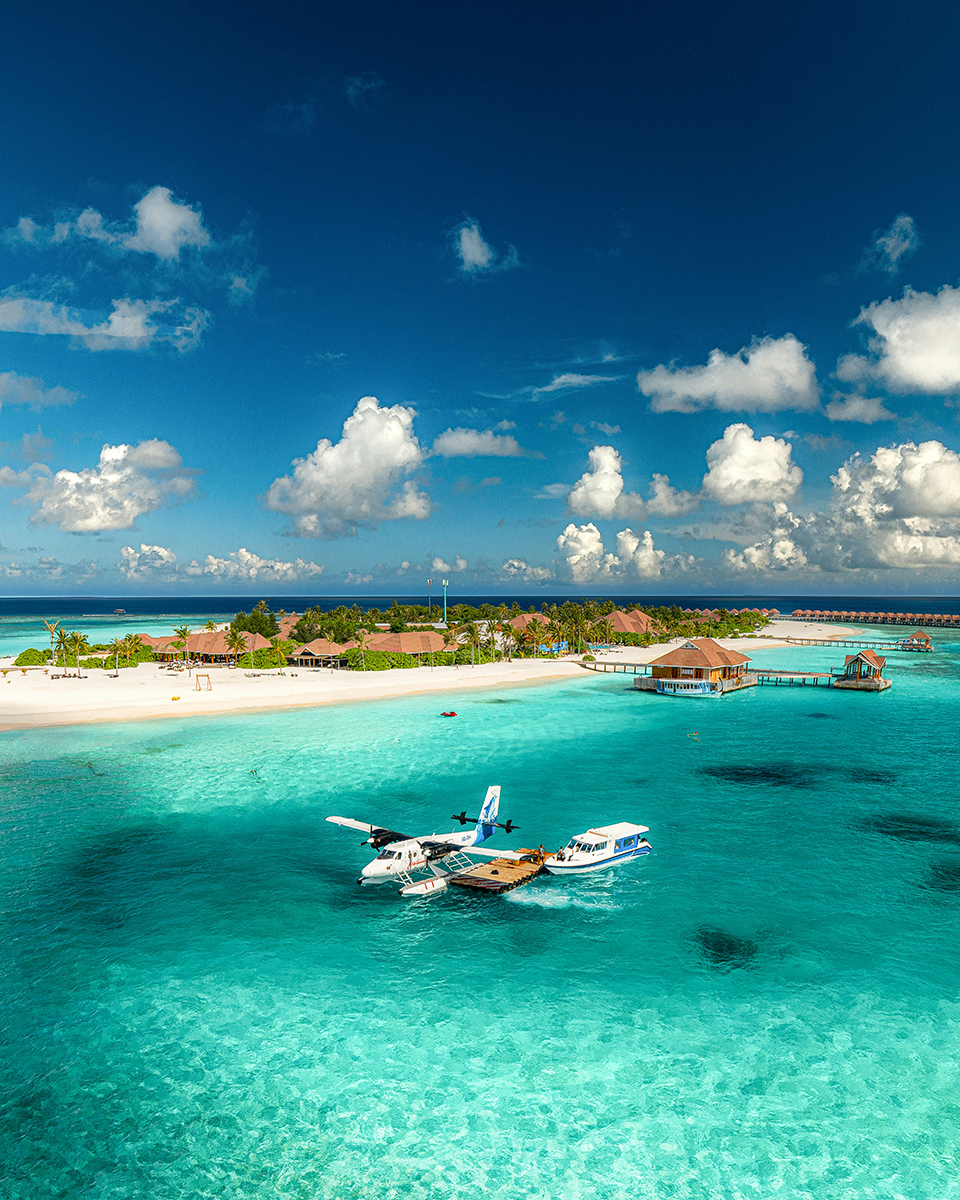
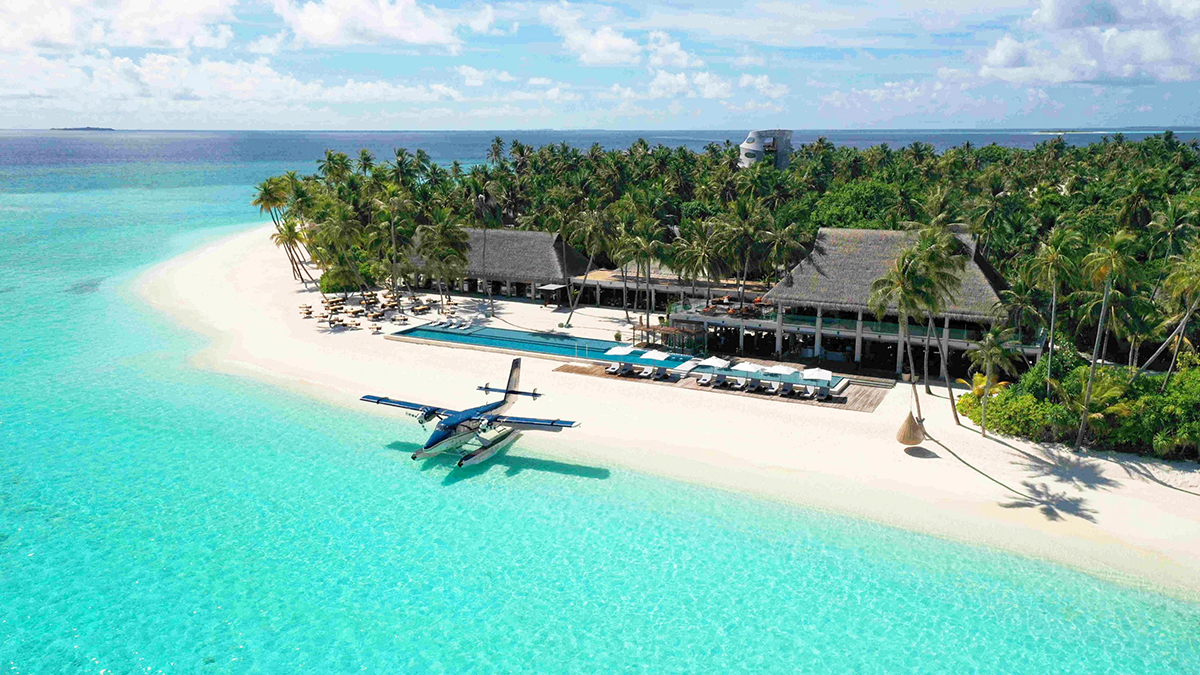
Getting to the Maldives Vellāna International Airport in Malé is the primary entry point. Direct connections operate from Bangkok, Singapore, Dubai, Colombo, Kuala Lumpur, and Mumbai; most European and Australian guests connect through one of these hubs. Onward transfers to the resort are by seaplane or speedboat depending on the atoll. South Ari Atoll takes roughly 30 minutes by seaplane; Lhaviyani and Dhaalu atolls around 40 minutes; Noonu Atoll around 45 minutes; and Baa Atoll around 30 minutes. Seaplanes operate only in daylight, so late-arriving guests typically overnight in Malé and transfer to the resort the following morning. The seaplane journey is, for most guests, the second-most memorable moment of the trip.
The reef was there first. The reef will be there last. The restaurants, in their most honest moments, know this about themselves, and have been designed accordingly.