
Amalfi Coast Italy
A timeless Mediterranean classic enters another season of slow mornings, sun-warmed stone, and the kind of beauty that refuses to be reinvented. NOW Travel Asia returns to Campania for an unhurried portrait of the coast in 2026.
THE ITALIAN CLASSIC
Why the Amalfi enters its 2026 season as the most quietly confident expression of la dolce vita in the Mediterranean.
Some destinations age. The Amalfi Coast simply ripens. Each summer it returns the way a well-loved aria returns, familiar in shape, fresh in feeling, sung again because there is still nothing better to sing. As 2026 unfolds along this slim, vertical ribbon of southern Italy, the coast is doing what it has always done best: catching the morning light on pastel walls, letting the sea exhale against the rocks, and reminding the traveler that beauty, when it is patient, never needs to shout.
The early summer arrives like a polite guest. The afternoons are warm but not yet brazen. The Tyrrhenian is dark and deep and just inviting enough to swim. The lemon trees, heavy with their long Sfusato fruit, perfume the lanes between Amalfi and Minori. And the rhythm, which by August will have surrendered to the slow shuffle of sandals on overheated stone, still feels miraculously its own. For the discerning traveler arriving in May, June, or even the polished afterglow of September, this is the coast at its most generous.
The Amalfi has been celebrated, painted, photographed, filmed, and quietly fallen in love with for so many centuries that one expects, on first arrival, to be disappointed. One never is. The cliffs really do plunge that dramatically into the sea. The villages really do seem to have been poured rather than built, dripping in pinks and ochres down the rock face. The air really does smell of citrus and basil and salt. There is no trick of angle, no flattering filter. The Amalfi simply looks like itself, and itself happens to be one of the most photogenic stretches of land on earth.
Yet what makes the coast endure, decade after decade, is not its scenery. Postcards age. The Amalfi does not. It survives because of something more interior: a culture that has, over a thousand years, learned to live elegantly within its own limits. There is no room here to sprawl, so people have learned to layer. There are no flat fields, so they terrace. There is little water, so they cherish it. The result is a civilisation built vertically, carved into the cliff itself, where every garden is borrowed and every view is earned. The Amalfi is not a coast you visit so much as a way of life you briefly join.
TIP
Explore Amalfi Coast early in the morning or near sunset to avoid the crowds and enjoy the coastline at its most beautiful, bathed in soft Mediterranean light.


A Republic of the Sea, Still Standing
UNESCO inscribed the Costiera Amalfitana on its World Heritage list in 1997, calling it an outstanding example of a Mediterranean landscape, of great cultural and physical value. The committee was being polite. The truth is that this fifty-kilometre stretch from Vietri sul Mare to Positano is not so much a landscape as a fugue, in which topography, agriculture, architecture, and trade have been improvising together for the better part of two thousand years.
In the 10th and 11th centuries, the Duchy of Amalfi was one of the four great Maritime Republics of Italy, alongside Venice, Genoa, and Pisa. Its merchants struck deals in Constantinople and Alexandria. Its sailors charted the Mediterranean with the help of the magnetic compass, which legend, perhaps too neatly, credits to a son of Amalfi named Flavio Gioia. The Republic was sacked by the Pisans in 1137 and then, more permanently, by the sea itself in 1343, when a tsunami swallowed much of the lower town. What remains today is a polished, sun-bleached fragment of that old maritime grandeur: the cathedral, the cloister, the chiseled facades, and a stubborn local pride that still refers to “the Republic” as if it had only recently closed for the season.
Amalfi the town is the obvious place to read this history aloud. The Cattedrale di Sant’Andrea presides over the central piazza like a stage set, sixty-two steep steps rising from the square to its striped Romanesque-Arab facade and golden mosaic tympanum. The relics of Saint Andrew the Apostle, brought from Constantinople in 1206 by Cardinal Peter of Capua during the Fourth Crusade, still rest in the crypt below. Beside the cathedral, the Chiostro del Paradiso, the Cloister of Paradise, was built between 1266 and 1268 to hold the bones of Amalfi’s nobility and now holds something more rare: silence. Slim white columns, paired and intertwined like dancing partners, support the slender Arab-Norman arches. The whole space feels less like a graveyard than a small, sun-filled hymn. The combined ticket for the cathedral complex, including the cloister, the crypt, and the diocesan museum housed in the older Basilica of the Crucifix, costs three euros and remains, by any measure, the best three euros in Campania.
Step back into the piazza and the present rushes back, kindly. Children chase pigeons. Couples queue for the morning sfogliatella at Pasticceria Pansa, the white-and-gold confectionery on the corner of the square that has been baking under that same name since 1830. A barman in a starched apron polishes glasses behind the door of the Bar Francese. The Republic, evidently, is still in business.


THE VERTICAL VILLAGE
Positano, the Color of Memory
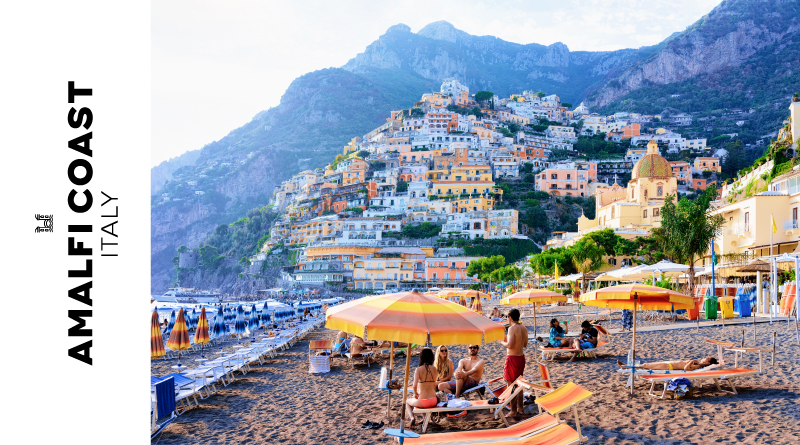
There is a moment, on the corkscrew descent of the SS163 from the pass above Positano, when the road turns and the village arranges itself below like an opera set just before the overture. The pastel houses cascade in disorderly grace, peach and apricot and faded lemon, all pinned to the cliff by lines of laundry and bursts of bougainvillea. Down below, the tiny pebbled crescent of Spiaggia Grande catches the sun. A church dome glints. Somebody, somewhere, is playing a Neapolitan song badly on an accordion. It is impossible, the first time, not to laugh aloud at the audacity of the place.
John Steinbeck, who arrived in 1953, wrote that Positano “bites deep” and “is a dream place that isn’t quite real when you are there and becomes beckoningly real after you have gone.” That assessment has aged remarkably well. The village has been polished by seventy years of fame, but the bones beneath are still those of a fishermen’s settlement, a place built for nets and not for crowds. The Via Positanesi d’America, named for the village’s 19th-century emigres, still threads down to the harbour as it always has. The pale-tiled dome of the Chiesa di Santa Maria Assunta still presides over the beach, with a 13th-century Byzantine icon of the Black Madonna inside. The ferries, when the sea is calm, still come and go from the small quay, because Positano has no proper port, only a sliver of pier, which is shut whenever the swell rises.
What has changed is the rhythm of arrival. The Travelmar and Alicost ferries that link Positano with Amalfi, Salerno, and Capri now run from the first of April through the end of October, and on a fair day in June the fifteen-minute hop to Amalfi by hydrofoil is one of the most agreeable transits in Europe. A glass of cold prosecco. The cliffs slipping past at sea level. The town receding behind, smaller and smaller, like a stage seen from a departing carriage. Anyone who has ever attempted the same journey by car, hostage to the legendary traffic of the Amalfitana, will swear off the road forever.
Positano in early summer rewards the slow traveler. Take the steep, stepped lanes uphill in the cool of the morning. Stop at the small terrace of La Tagliata in Montepertuso for a long, family-style lunch with one of the most extravagant views in Italy. Pause at Da Adolfo, the old beach shack at Laurito reachable only by complimentary boat from the Spiaggia Grande, where lunch is grilled mozzarella on lemon leaves, paccheri with octopus, and a chilled white sangria that tastes like a holiday distilled. In the afternoon, swim from a hired sun bed at Spiaggia di Fornillo, marginally quieter than the main beach, and watch the cliffs change colour as the sun moves west.
At dusk, the village does its slow theatrical trick. The lights come on in the windows of the houses up the slope, one by one, and the whole hillside begins to look as though it has been wired for a private opera. From the candle-lit terrace of La Sponda at Le Sirenuse, where four hundred candles are lit by hand each evening, the view does not feel quite real. It feels remembered.


THE GARDEN IN THE SKY
Climb the SS373 from Atrani in the soft hour after breakfast, and the world begins to thin. The houses fall away. The lemon groves take over. The road tightens and twists, and then, abruptly, you are 365 metres above the sea, in a small hilltop town where the air is cooler, the silence is older, and the view is so vast that the horizon itself appears to have stepped backwards to oblige.
Ravello is the Amalfi for those who have come for ideas. Wagner finished the second act of Parsifal here in 1880, sketching the magic garden of Klingsor in the gardens of Villa Rufolo. D. H. Lawrence completed Lady Chatterley’s Lover up the road. Greta Garbo took refuge with Leopold Stokowski in the early 1930s, hoping to be invisible and being, of course, photographed. Gore Vidal lived just outside town for thirty years, and once observed, with the world-weary precision he was famous for, that the view from Ravello was “the most beautiful in the world.”
Vidal had two villas in mind. Villa Rufolo, hidden behind a Norman-Saracen tower at the edge of the main piazza, was built in the 13th century by the Rufolo family of merchants, then rediscovered in the 19th by a Scottish industrialist named Francis Nevile Reid, who restored its terraced gardens to their present, exquisite form. Villa Cimbrone, a half-hour walk south through quiet lanes, was reimagined in 1904 by Lord Grimthorpe, an English aristocrat in flight from a complicated personal life, who built the famous Terrace of Infinity along the cliff edge. The terrace is lined with eighteen marble busts gazing seaward, and the view, on a clear morning, takes in the entire arc of the coast from Capo d’Orso to the islands of Li Galli. Vidal was not exaggerating.


Each summer, Villa Rufolo becomes the open-air heart of the Ravello Festival, the venerable music festival founded in 1953 in homage to Wagner. The 2026 edition runs from June through late September, with most concerts staged on the clifftop Belvedere, an 1,200-seat platform that appears, by the sleight of hand of clever engineering, to float over the void. Programmes range from chamber recitals at the medieval Annunziata hall to symphonic evenings at the Auditorium Oscar Niemeyer, the swooping concrete shell designed by the late Brazilian architect just before his death. Tickets begin at thirty euros. The headline concerts sell out within days of release, usually in late spring.
There are gentler ways to take Ravello. Walk the Via dei Rufolo to the cathedral, founded in 1086 and home to a celebrated 12th-century pulpit set on six twisting columns supported by lions. Stop at the Caffe Calce in the piazza for a granita di limone made with the local Sfusato fruit. Then climb to La Piscina, A Caruso Pool Club, set beside the celebrated infinity pool of Belmond’s Caruso. The pool itself, more than a hundred metres above the sea, is one of the most photographed in Italy and well deserves the attention. Settle into a daybed. Order a bowl of spaghetti alle vongole and a glass of cold Falanghina. Drift through the afternoon. The horizon, here, is on permanent and silent loan.
TIP
Visit Ravello early morning or at sunset for the best views and fewer crowds. Wear comfortable shoes, as the town’s charming stone streets and hills are best explored on foot.


A TABLE BY THE TYRRHENIAN
The Edible Soul of Campania
To eat along the Amalfi Coast is to be reminded that Italian cuisine is, in the end, a cuisine of place. Nothing on the plate has travelled far. The mozzarella di bufala arrives that morning from Paestum, just down the coast. The tomatoes, the famous San Marzano and the smaller, sweeter Piennolo del Vesuvio, were on the vine yesterday on the slopes of the volcano. The flour for the pasta comes from the ancient grain mills of the inland Cilento. And the fish, of course, was alive at dawn.
The most local of all local specialities is the colatura di alici, the prized anchovy essence produced in the small fishing village of Cetara, at the eastern end of the coast. A descendant of the Roman garum, it is made by layering blue Mediterranean anchovies and sea salt in chestnut-wood barrels and pressing them, slowly, for months. The amber liquid that emerges, recognised in 2020 by a European Protected Designation of Origin, is the secret of perhaps the most beloved pasta on the coast: spaghetti alla colatura, dressed with nothing more than a spoon of the essence, a glug of good oil, garlic, parsley, and a crack of pepper. The dish takes four minutes to make and a lifetime to forget.
Up the road in the hills of Sant’Agata sui Due Golfi, Don Alfonso 1890 holds two Michelin stars and a kind of paternal authority over the gastronomy of the south. The family-run restaurant, which doubles as a Relais & Chateaux hotel, draws much of its produce from its own organic farm at Punta Campanella. Chef Ernesto Iaccarino’s tasting menu reads as a thoughtful essay on Campanian heritage, with quiet flourishes of contemporary technique. The cellar, hewn into the tufa beneath the dining room and dating back, in places, to pre-Roman times, holds more than 25,000 bottles. To dine here, then to descend to the cellar by candlelight with the sommelier, is to experience the Amalfi as it most likes to present itself: serious, generous, and a little theatrical.
Closer to the sea, La Sponda at Le Sirenuse remains the most romantic dining room in Positano, and probably in southern Italy. Recognised again in the 2026 Michelin Guide, the restaurant operates from a flagstone terrace ringed by lemon trees, with Neapolitan chef Gennaro Russo presiding over a menu that is unapologetically Mediterranean. Hand-cut tagliolini with lemon and Cetara anchovies. Acquerello risotto with sea urchin. Linguine al pomodoro that tastes, somehow, of every August you have ever loved. At nightfall the four hundred hand-lit candles do their work, and the scene becomes the kind of memory people invent for themselves in middle age and pretend they really had.
On the seafront in Amalfi, Marina Grande remains the address for pesce all’acqua pazza, fish poached in a broth of tomato, capers, and “crazy water,” cooked simply because the fish, that morning, was perfect. In Praiano, the family-run Trattoria da Armandino at the Marina di Praia hauls its catch up the steep stone steps from the boats themselves. And in Cetara, Al Convento serves an austere, ravishing tonnarelli with colatura that the village has every right to consider its own.
Then there are the simpler pleasures. The morning espresso at the bar in your own pyjamas, ordered from a barista who already knows. The afternoon granita di caffe with whipped cream that makes the heat tolerable. The 6 p.m. aperitivo of a Negroni Sbagliato, prosecco swapped in for the gin, served with bowls of warm taralli and small green olives. And finally, after dinner, the cool yellow shock of a glass of limoncello poured from a frozen bottle, the local digestivo that has, by now, conquered every Italian restaurant in the world but remains, in its homeland, somehow infinitely better.


Lemons, Lace, and Lacquered Tile
Behind the postcard view of the Amalfi lies a coast at work. The terraces themselves are the first clue. Some 100,000 metres of dry-stone walls, called macere, climb the cliffs above the towns, supporting the soil on which the Sfusato Amalfitano lemon has been cultivated since at least the 12th century. The sfusato, named for its tapered, spindle-shaped form, is a fragrant, low-acidity citrus with a thick aromatic peel that is sweet enough to eat raw, the way locals once sliced it onto bread with a little salt and oil. It has been recognised since 2001 with a European Protected Geographical Indication, and is the basis for some 56,000 certified bottles of limoncello produced each year by the small cooperatives of the coast.
A morning at one of the lemon farms above Amalfi, the Locanda degli Agrumi or the Aceto family’s historic terraces, is a quiet revelation. You climb between rows of trees roofed with chestnut pergolas, the fruit hanging in startling green and gold above your head. You watch how the lemons are picked one at a time, with a gloved hand and a small twist of the wrist. You taste the rind, then the sorbet, then a small glass of the family limoncello, which is paler and sharper and more alive than any version you can find at home. Most farms now offer a half-day visit with tasting and lunch on the terrace for around 70 euros. They are among the best things to do on the coast.
From lemons, walk to paper. Above the town of Amalfi, the wild gorge of the Valle delle Ferriere holds the haunting ruins of the medieval paper mills that once made Amalfi famous across Europe. The republic produced its first paper in the 12th century, learning the craft from Arab traders, and for centuries supplied the Vatican itself. Today the Cartiera Amatruda, founded in 1380 and still run by the same family, continues to make handmade cotton paper using the original water-powered methods. Visit the small Museo della Carta in town to see the great wooden hammers and stone basins still in working order. Then walk an hour up the gorge into the nature reserve, beneath ferns and waterfalls, past the moss-covered shells of the abandoned mills. It is the closest thing the coast has to a fairy-tale.
On the eastern edge of the coast, the small town of Vietri sul Mare has been the centre of southern Italian ceramics since the 15th century. Its workshops still hand-paint the bright lemon-yellow plates, the cobalt-and-citrus tiles, and the famous “ciucciariello” donkey figurines that line the village streets. Choose a piece directly from a working studio rather than a tourist shop. The price is honest, and the work, which often takes a single artisan a full day, is beautiful enough to outlive the holiday by a long, long while.


BEYOND THE POSTCARD
A Coast Less Photographed
Even now, with the Amalfi at the height of its global fame, there are corners of it where the postcard quietly gives way to something more private. They are not far from the famous towns. They simply ask the visitor to slow down a little further.
Atrani, the smallest town with the largest heart
A five-minute walk east of Amalfi, around the headland, lies Atrani, officially the smallest town in Italy by area and one of the most enchanting places on the coast. The square, the Piazza Umberto I, sits just behind a small pebble beach and is shaded by a single broad arch. Children play football against the church wall. Old men argue, gently, about the football. The Chiesa di San Salvatore de Birecto, where the doges of the Amalfi republic were once crowned, presides quietly. A meal at A’ Paranza, the Michelin-listed seafood restaurant tucked into a cellar a few steps off the square, may well be the best lunch you eat all week.
Furore, the village without a centre
Between Amalfi and Positano, hidden in a cleft of the cliffs, the Fiordo di Furore is the only true fjord on the Italian peninsula. A single tall stone bridge crosses the inlet, far above the water. Below it, a tiny pebble beach is reached by 300 steps cut into the rock and is dominated by a handful of stone fishermen’s houses, many of them now museum pieces of vernacular architecture. The village of Furore proper has no real centre. It is scattered, instead, in painted houses across the hills above, hung with vivid murals and looking down on the sea. Each July it hosts a small high-diving competition off the bridge, the Marmeeting, a curiosity for those who happen to be passing.
Cetara, where the anchovies still come in by hand
At the eastern end of the coast, beyond Maiori and Minori, Cetara remains a working fishing village, with one of the last small tuna fleets in the Tyrrhenian and a tradition, going back to Roman times, of preserving the spring anchovy in salt and pressing the resulting essence. Walk the small harbour at dawn to watch the boats come in. Then take an early lunch at Al Convento or Acquapazza, two of the addresses that put Cetara on the gastronomic map. The town has none of the obvious gloss of Positano. That is precisely the point.
Praiano and Marina di Praia, the secret west
Quieter than Positano, lower than Ravello, Praiano is the village many visitors learn to love after their first trip. Its small, deep cove of Marina di Praia is sheltered between two cliffs and shaded, even in August, until late morning. The 13th-century Torre a Mare, an old Saracen watchtower, now houses an art studio. The walk along the Sentiero Lucia at sunset, with the light setting fire to the cliffs of Praiano, is the kind of small private rapture the coast was made for.


SALT AND SOLITUDE
The Path of the Gods
No description of the Amalfi is complete without a few hours spent above it, on the high stone trails the locals have walked for centuries between their villages and their fields. The most celebrated of these is the Sentiero degli Dei, the Path of the Gods, which follows the cliffside from the small hilltop hamlet of Bomerano, in the village of Agerola, west to Nocelle, an outpost of Positano hung above the sea at 450 metres.
The trail is six and a half kilometres of soft, undulating walking, with a moderate descent at the end. Mediterranean scrub closes around you for the first hour. Then the trail opens, and the cliffs unfurl below in one of the great walking views in Europe. To the south, the islands of Li Galli, said by the ancients to be the home of the sirens. Beyond them, on a clear morning, the unmistakable silhouette of Capri and its Faraglioni rocks. Beneath your feet, terraces of vines and lemon trees. Above, the cry of a peregrine.
Allow three to four hours including stops, and consider walking from east to west, beginning in Bomerano and finishing in Nocelle, so that the views unfold in front of you and the long descent at the end takes you down rather than up. Pause for an early lemonade at the Chiosco degli Dei, the small wooden kiosk halfway along the trail. Lunch, if you can time it well, at La Tagliata in Montepertuso, where the family menu and the Capri view are both, in their way, unforgettable. The 1,500 stone steps that descend from Nocelle to Positano at the end are a quad-burning grand finale, but a SITA bus also runs the same route to Positano below.
The best months for the walk are April, May, early June, September, and October. In high summer the sun on the exposed sections is fierce. The trailhead at Bomerano is reached by SITA bus 5080 from Amalfi (about 40 minutes, 2.20 euros), or by a private transfer arranged through any hotel.


On the Water: Capri, the Blue Grotto, and the Sirens of Li Galli
The other natural extension of an Amalfi week is a day on the water. The classic outing is a small private boat from Positano around the islands of Li Galli (privately owned and once the home of the great Russian dancer Rudolf Nureyev) and on to Capri. Most operators leave at nine in the morning and return after sunset. Expect to pay between 700 and 1,200 euros for a small group of four to six. The route takes in the Faraglioni rocks, the celebrated Grotta Azzurra (the Blue Grotto, entrance fee 18 euros, queue early), the wilder Grotta Verde, and a long lunch on the island, perhaps at Da Paolino in Capri town, with its tables set under a canopy of lemon trees.
Those allergic to crowds will prefer the smaller, quieter alternative: the Grotta dello Smeraldo, the Emerald Grotto, off the coast at Conca dei Marini, easily reached from Amalfi by ferry or by a steep elevator from the cliff road. The light here is filtered green rather than the famous blue, and the cave, while less spectacular than its Capri counterpart, is rarely full.
TIP
Arrive early to enjoy Capri before the crowds. Morning light is ideal for exploring Piazzetta, Via Krupp, and the iconic Faraglioni with a quieter atmosphere and better photo opportunities.


THE CAFE HOUR
Some of the most enduring memories of an Amalfi visit will not be made on a beach or a clifftop. They will be made in the unhurried minutes spent at a cafe table, watching the village do what it has done for a thousand years. These are three of the addresses worth planning the day around.
Pasticceria Pansa, Amalfi
On the corner of Amalfi’s cathedral square, beneath gilded mirrors and white-marble counters, Pasticceria Pansa has been baking since 1830. Five generations of the Pansa family have presided over this small confectionery, and the pleasure of stepping inside has not noticeably changed since the 19th century. Order the sfogliatella, the conch-shaped Neapolitan pastry of paper-thin layers and warm ricotta filling. Or the delizia al limone, a small dome of sponge soaked in limoncello cream, an Amalfi invention now copied across Italy. Take it standing at the counter, with an espresso, the way the locals do. The bill will be small. The memory will not.

Masaniello Art Cafe, Atrani
Tucked into the cobbled lanes of Atrani, just off the Piazza Umberto, Masaniello is a small, low-ceilinged room where coffee, art, and conversation seem to have been quietly conspiring since long before the present owners thought to hang a few of their friends’ paintings on the wall. There are good cocktails in the evening, light bites at lunch, and a tendency, on a warm night, for the place to fill with the kind of regulars who have known each other since school. It is the antidote to the more polished cafes of Positano, and a perfect pause in the afternoon before the climb back to your hotel.


Belvedere Restaurant at Caruso, Ravello
High above the coast, on the terrace of Belmond’s Caruso, the Belvedere Restaurant offers what is arguably the most cinematic dinner table on the Amalfi. The dining room sits at the very edge of the cliff, ringed by century-old wisteria and a horizon that, by candlelight, appears to be lit from within. The kitchen, under the direction of executive chef Armando Aristarco, draws on the gardens of the property and the markets of nearby Tramonti for an intelligent, restrained Mediterranean menu: linguine with red prawns and lemon, line-caught fish in a salt crust, a millefoglie of summer fruit. Reservations should be made at the time of booking the room. The sunset arrives, by long-standing arrangement, at no extra charge.
Dining at Belvedere Restaurant in Caruso, A Belmond Hotel, Amalfi Coast is best booked early, especially for sunset terrace seats. Expect a scenic mountain drive, rewarded by one of the most breathtaking dining views on the Amalfi Coast.


Iconic Stays of the Amalfi Coast
Il San Pietro di Positano
Just outside Positano on the road to Praiano, the cliffside Il San Pietro is the antithesis of its in-town neighbour: secluded, hushed, and built into the rock with a discipline that recalls the great cliffside monasteries of Greece. There are 57 rooms and suites, all with private terraces draped in bougainvillea, and an extraordinary lift cut directly through the cliff that delivers guests, without fanfare, to a private beach club, a saltwater swimming platform, and a clay tennis court at sea level. The Michelin-starred Zass restaurant, under chef Alois Vanlangenaeker, is one of the quiet pleasures of the coast. So is breakfast on the upper terrace, with the sea below and not another soul in sight.


Caruso, A Belmond Hotel, Ravello
In an 11th-century palazzo at the highest point of Ravello, Caruso is the grande dame of the upper coast. Restored by Belmond and reopened in its current form in 2005, the hotel is built around a cloistered courtyard, a pair of frescoed reception rooms with original ceilings, and the now-iconic infinity pool that floats, more than a hundred metres above the sea, on the very edge of the cliff. The hotel operates seasonally and reopens for its 2026 season on 16 April. Lavender and lemon scent the gardens. The poolside Belvedere restaurant, mentioned above, anchors the day. And the rooms, all 50 of them, manage the rare trick of feeling at once palatial and personal.


TRAVEL NOTES
Navigating the Coast in 2026
A few things to know before you arrive. The Amalfi Coast is small in size and large in logistics. A little planning, gently applied, will make the difference between an effortless week and a frustrated one.
Getting In
The natural arrival airport is Naples International (NAP), about 60 kilometres from Positano. From the airport, the simplest transfer is a private car (around 130 to 180 euros for two passengers, two hours). For those willing to stitch together public transport, the Curreri shuttle bus runs from the airport to Sorrento, from where the EAV Circumvesuviana train, the SITA Sud bus, or, ideally between April and October, the seasonal Alilauro and Travelmar ferries continue around the Sorrento peninsula to Positano and Amalfi. The ferry approach, on a calm morning, is the most beautiful first glimpse of the coast.
When to Go
The classic sweet spots are mid-April to mid-June and the second half of September through October. July and August are the hottest, busiest, and most expensive months, and unless one is committed to a specific event such as the Ravello Festival, the shoulder months will reward the traveler more generously.
What to Pack
Linen, in every form. A pair of soft-soled flats for the cobbled lanes, which are unforgiving in heels. A long-sleeved cotton or silk shirt for the cooler evenings on Ravello’s terraces. A wide-brimmed straw hat for the boat. One slightly serious dress or jacket for La Sponda, Don Alfonso, and Belvedere. And a leather tote large enough to carry home a bottle of limoncello, a wedge of caciocavallo, and a small ceramic bowl from Vietri.